
Life, the Universe, and Restaurants Restaurant Management
Master Life, the Universe, and Restaurants restaurant management with tips for robot automation, kitchen layouts, menu strategy, and five-star progression.
Jump to
Understand the Restaurant Management Loop
Your next unhappy diner could become the brain behind your kitchen staff. Life, the Universe, and Restaurants restaurant management combines cooking, robot automation, business strategy, and defense, so every expansion changes more than your seating capacity. Getting Life, the Universe, and Restaurants restaurant management right means keeping orders moving while deciding how to handle customers who call themselves gods.
You begin with hands-on food service. Take an order, gather ingredients, prepare them, plate the dish, and deliver it to the customer. As business grows, those individual actions become a production problem: more tables create more orders, and more complicated recipes introduce additional preparation steps.
The restaurant’s progression runs from one star to five stars through business objectives. Coins fund expansion and equipment, while Brains support talents and more powerful robots. Serving dinner and defending the building therefore feed different parts of your development.
| System | What you do | What to watch |
|---|---|---|
| Cooking | Gather, process, plate, and serve ingredients | Preparation steps and delivery time |
| Expansion | Purchase plots, cookware, tables, and production facilities | Kitchen capacity relative to seating |
| Automation | Record routines and assign robot staff | How tasks connect across the restaurant |
| Marketing | Use ads to influence orders and dish profits | Demand for the dishes you promote |
| Defense | Deal with enraged customers and protect facilities | Combat readiness before provoking diners |
Start by following an entire order from the customer’s table to the finished meal. Notice which actions repeatedly pull you away from cooking. Those interruptions identify jobs to automate later.
The demo also makes collecting revenue a physical task. Customers drop Coins, which you carry to a vault before they become available funds. Include that trip when planning your workload; finishing a meal does not finish every job attached to the sale.
Build a Layout That Can Support Five Stars
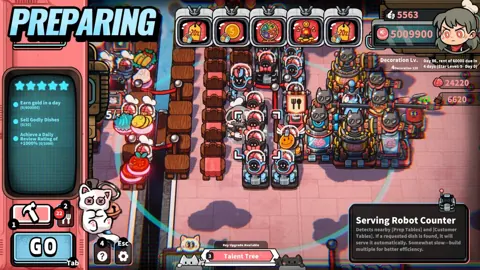
Life, the Universe, and Restaurants restaurant management rewards attention to traffic flow. Your chef moves between ingredient containers, preparation equipment, plates, and customer tables. Robot staff also need to perform their assigned jobs within the restaurant you build.
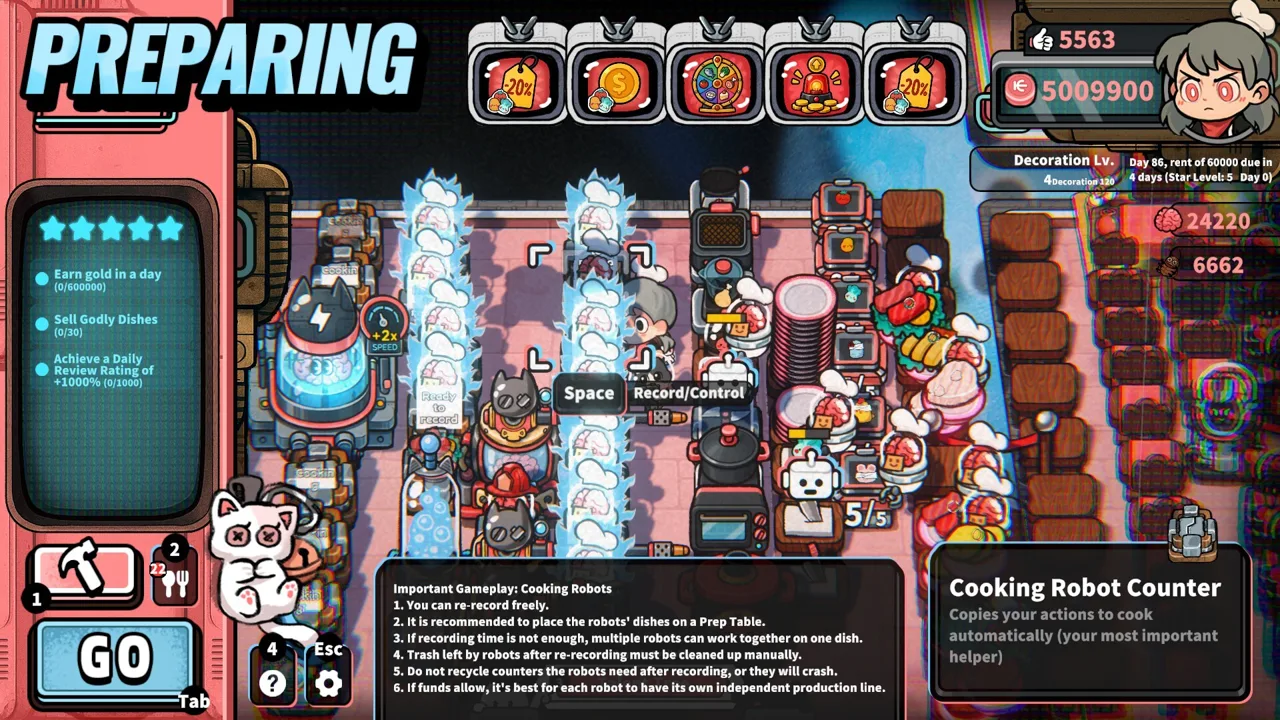 Image: Steam / GARRY
Arrange equipment around the sequence of a recipe. Keep the transition from ingredients to processing to plating easy to follow, then consider the trip to the dining area. Avoid scattering related stations across an expanded floor simply because you have room.
More seating increases the number of customers you can accommodate, but cooking and serving still take work. Expand the production side alongside the dining room rather than treating every new plot as space for more tables.
| Expansion choice | Supported function | Planning tip |
|---|---|---|
| Customer Tables | Seat additional diners | Check cooking and serving capacity before adding more |
| Cookware and production facilities | Support food preparation | Group equipment used in the same preparation sequence |
| New plots | Increase restaurant space | Plan the routes between kitchen and dining areas |
| Robot staff | Handle restaurant tasks | Assign help to the job currently slowing service |
| Star upgrades | Open additional purchasable content and systems | Read the current business objectives before spending |
Star progression gives expansion a clear purpose. Completing each stage’s objectives advances the restaurant toward five stars, with additional recipes, structures, robots, ads, talents, and management systems opening as your rating rises.
Review those objectives before purchasing equipment. Spend toward the requirements you are working on, and consider how the purchase will fit into the restaurant’s next production line.
Higher-tier recipes bring increasingly involved preparation. Leave room to arrange multiple Cooking Robots in sequence when you redesign the kitchen. A layout that works for a simple salad deserves another look once your menu demands more processing.
After expanding, follow the same order route again. Check whether the extra space has shortened useful trips or merely spread the work farther apart.
Teach Robots a Routine Worth Repeating
Automation is central to Life, the Universe, and Restaurants restaurant management. You record a cooking routine, and robots repeat it. Their roles extend beyond the stove: robot staff can take orders, serve dishes, transport Coins, and clean up.
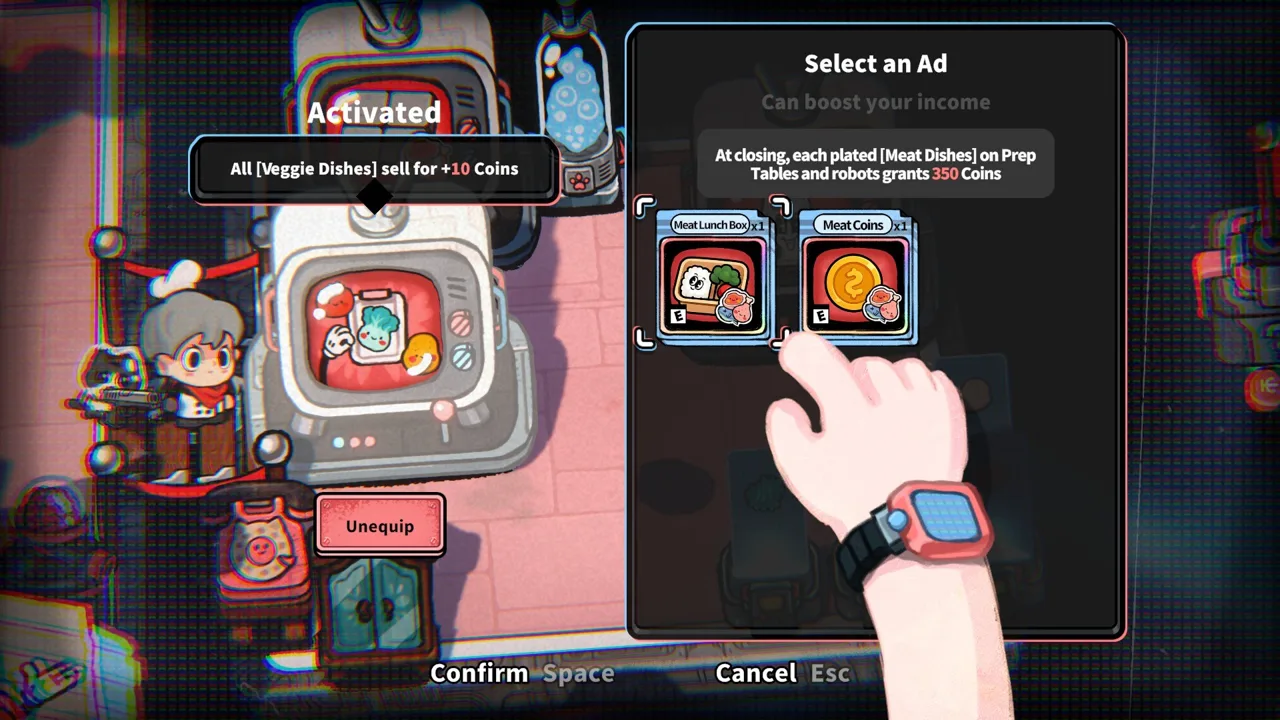 Image: Steam / GARRY
That makes the routine itself important. Before recording, arrange the required equipment and practice the preparation sequence. Remove unnecessary movement from the demonstration so the work you hand over follows a deliberate route.
For complicated recipes, the game supports multiple Cooking Robots working in sequence. Divide your attention between the individual preparation steps and the handoff that connects them. Completing one task quickly helps only when the next stage can keep up.
| Robot task | What it handles | What to check afterward |
|---|---|---|
| Taking orders | Customer requests | Whether the kitchen can process incoming work |
| Cooking | Recorded preparation routines | Whether successive preparation stages connect |
| Serving | Delivery of finished dishes | Whether prepared food reaches customers promptly |
| Transporting Coins | Movement of restaurant earnings | Whether revenue collection keeps pace with service |
| Cleaning | Cleanup work | Whether other restaurant duties still need attention |
Automate a frequent interruption, then watch the remaining workload. If cooking becomes easier but you still spend your time delivering plates, turn your attention to serving. If the dining room runs smoothly while Coin collection occupies the chef, examine that job next.
Avoid assigning every available robot to cooking by default. Orders, delivery, earnings, and cleanup all belong to the same business. Balance staff around the work your restaurant actually generates.
In Life, the Universe, and Restaurants restaurant management, think of automation as a connected workflow. A fast preparation station can still leave you waiting on another step, and additional cooks do not perform the server’s job.
Observe a complete meal cycle after introducing a robot. Follow the order through preparation and delivery, then check the supporting tasks. Use that full cycle to decide what needs attention next.
Match Your Menu, Ads, and Prices
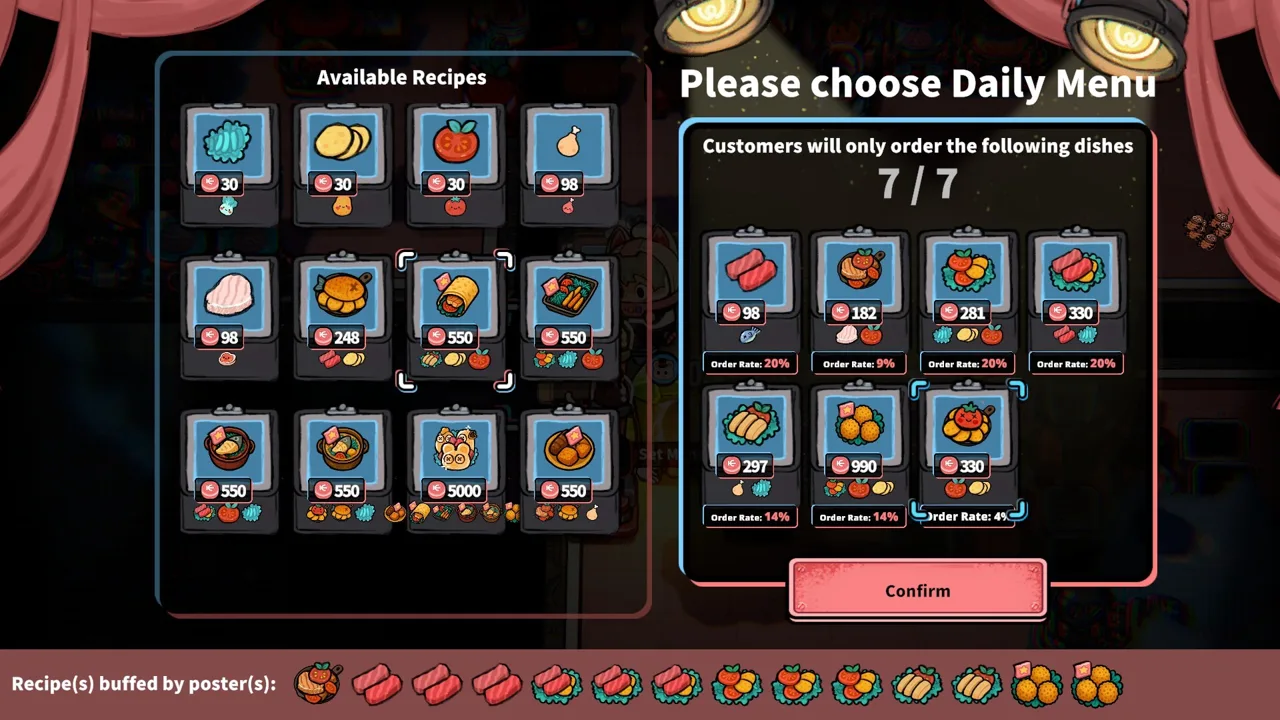
Your menu gives you another way to shape the workload. The game supports promoting a dish repeatedly, rotating selections, and specializing in Veggie Dishes or Meat Dishes. Business strategy also involves dish prices, order rates, serving speed, and automation efficiency.
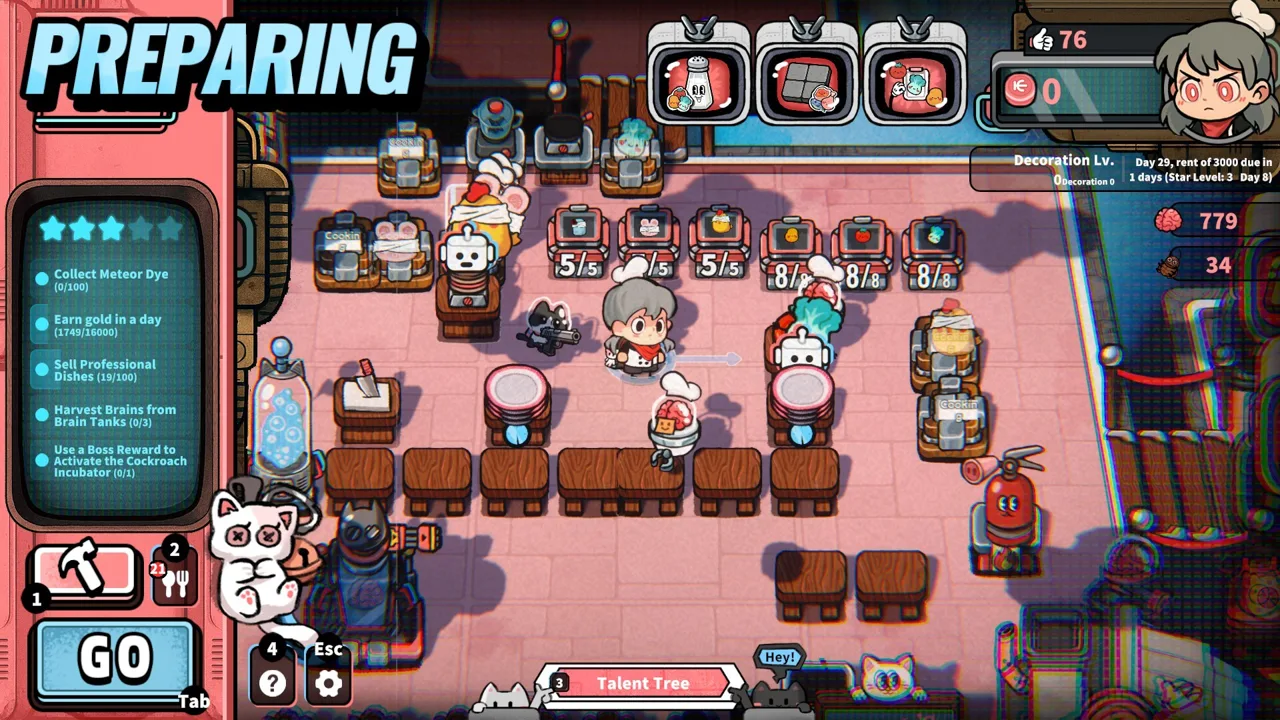 Image: Steam / GARRY
Life, the Universe, and Restaurants restaurant management connects those decisions through advertising. Posters make customers more likely to choose particular dishes, while TVs steer orders toward a selected menu. Different ads can also improve profits from specific dishes.
Promote food your kitchen is prepared to produce. If a recipe involves several steps, organize those steps before encouraging more customers to order it. Advertising changes demand; the kitchen still has to complete the work.
| Business tool | What it affects | Practical tip |
|---|---|---|
| Posters | Customers’ likelihood of ordering particular dishes | Feature a dish with a prepared cooking routine |
| TVs | Orders directed toward a selected menu | Coordinate the promoted menu with your production setup |
| Dish specialization | Focus on Veggie Dishes or Meat Dishes | Organize staff and equipment around the chosen recipes |
| Menu rotation | Changes the dishes you emphasize | Review preparation needs when switching focus |
| Pricing strategy | Uses factors including queues, Coins, and special events | Consider serving speed alongside price increases |
Compare recipes by their preparation requirements as well as their selling potential. A dish with more steps needs a different production arrangement than a simple meal. Give the equipment and robot assignments the same attention you give the menu.
Dish-specific skill trees provide another development path. Cooking improvements can increase a dish’s value, giving you a reason to align recipe development with what you advertise.
Choose a featured dish, prepare its workflow, and then direct orders toward it. When rotating the menu, review the entire chain again rather than assuming the previous setup suits every recipe.
Keep pricing connected to service. Higher prices belong within a broader strategy that includes how quickly meals reach the tables and how much work automation handles. Use the restaurant’s management systems together instead of pursuing revenue through one setting alone.
Handle Angry Gods and Spend Brains With Purpose
The dining room can become a battlefield. Customers who exhaust their patience turn aggressive and can attack restaurant facilities. The game’s fictional Cosmic Regulatory Bureau permits self-defense against these unruly diners, allowing you to harvest their Brains.
Those Brains upgrade talents and unlock more powerful brain-based robots. Turret Robots, Guards, and other Defense Facilities protect the restaurant. Space roaches add another threat to manage alongside demanding customers.
Life, the Universe, and Restaurants restaurant management lets you deliberately push diners toward anger. Trash Bins, lighting, and other methods can drain patience, turning customer treatment into a resource decision as well as a service decision.
Prepare defenses before pursuing that route. Provoking customers brings hostile behavior into the same space where your kitchen and dining facilities operate. Consider the protection those facilities need before arranging conditions that encourage rage.
Keep the two resource goals clear:
- Earn Coins through service to purchase cookware, plots, and other restaurant improvements.
- Use harvested Brains for talents and more powerful brain-based robots.
- Deploy defensive units and facilities before deliberately creating more confrontations.
- Review kitchen performance after upgrades so new capabilities support your current business objectives.
The tension comes from the connection between these systems. Good service earns money for growth, while confrontations supply a resource used in another part of progression. Decide which development goal you are pursuing before changing the dining room.
The cartoon style accompanies dark humor and violence, including killing hostile customers and harvesting their brains. Expect cooking pressure and combat alongside the colorful restaurant setting.
For a first session, focus on learning the manual meal loop, working through business objectives, and recording useful robot routines. Explore deliberate provocation once you understand the defense tools available to your restaurant.
Visit the Life, the Universe, and Restaurants Steam page to access the demo and try its combination of food service, automation, and restaurant defense.
FAQ
How does Life, the Universe, and Restaurants restaurant management work?
You take orders, prepare and serve dishes, earn Coins, and expand your restaurant. Robots automate cooking and supporting tasks, ads influence customer choices, and defenses protect the business from hostile customers and space pests.
How do you upgrade your restaurant to five stars?
Complete the business objectives at each stage to advance from one star to five stars. Increasing your Star Rating opens more purchasable plots, recipes, structures, robots, ads, talents, and management systems.
What are Brains used for?
Brains harvested from enraged customers upgrade talents and unlock more powerful brain-based robots. They connect the game’s self-defense mechanics with restaurant development and automation.
What platforms support the game, and is there a demo?
The game supports Windows and single-player play, with full controller support. A Steam demo is available. Its scheduled release date is October 12, 2026, and the minimum PC requirements include Windows 10 or 11 64-bit, 8 GB RAM, and 1 GB of available storage.
Continue with
 Life, the Universe, and Restaurants Space Roaches: GuideLife, the Universe, and Restaurants space roaches threaten your cosmic eatery. Learn how defense, robot automation, and smart layouts fit your strategy.
More in Restaurant
Life, the Universe, and Restaurants Coin Collection Guide
Master Life, the Universe, and Restaurants coin collection with vault routes, transport robots, ad strategies, and practical tips to grow daily income.
Life, the Universe, and Restaurants Commercials Guide
Life, the Universe, and Restaurants commercials boost dish income and shape your menu. Learn how to use TVs, posters, and robots to earn more during shifts.
Life, the Universe, and Restaurants Customer Attacks: Guide
Life, the Universe, and Restaurants customer attacks turn angry gods into Brains. Learn patience triggers, defense options, and smarter robot strategies.
Life, the Universe, and Restaurants Customer Patience: Tips
Master Life, the Universe, and Restaurants customer patience: serve faster, manage trash bins, harvest brains, and build robots to keep service moving.
Join the community
Official channels for news, updates and player help: