
Life, the Universe, and Restaurants Plating: Fast Service
Master Life, the Universe, and Restaurants plating with salad steps, kitchen layout tips, and robot routines. Keep dishes moving and serve hungry gods.
Jump to
How Plating Fits Into the Cooking Loop
A hungry god is waiting, your ingredients are chopped, and dinner still needs to reach the table. Life, the Universe, and Restaurants plating connects finished preparation to service, making it an essential part of keeping orders moving. Master Life, the Universe, and Restaurants plating early so your kitchen routine carries each dish from ingredient pickup through delivery.
You run a restaurant in space, serving customers who call themselves gods. Cooking starts as hands-on work: take an order, gather ingredients, process them, plate the dish, and carry it to the customer. As business grows, robots can repeat recorded routines and take over cooking, serving, cleaning, and transporting Coins.
That puts plating between two jobs that deserve equal attention. Preparation produces the food; delivery completes the service. Keep both sides of that handoff in mind when arranging your kitchen or teaching a robot.
| Stage | What happens | What to check |
|---|---|---|
| Order taking | A seated customer requests a dish | Which recipe the customer wants |
| Ingredient pickup | You collect the required ingredient | Whether it matches the order |
| Preparation | You perform the recipe’s processing steps | Whether those steps are finished |
| Plating | You put the prepared food onto a plate | Whether the dish is ready to carry |
| Serving | You deliver the plated dish | Which customer ordered it |
Follow the whole sequence before starting another task. During a rush, switching between taking orders, preparing food, and collecting money can make it easy to lose track of where a dish belongs.
For Life, the Universe, and Restaurants plating, build a repeatable habit: check the order, finish the recipe, plate it, and remember its destination.
Plate Leafy Salad Without Losing the Order
Leafy Salad gives you a straightforward introduction to preparing and plating food. In the early-development tutorial, a seated god orders the salad, and you collect a Leafy Folk from its container. You then place it on the Cutting Counter, slice it, pick up the sliced ingredient, and plate it.
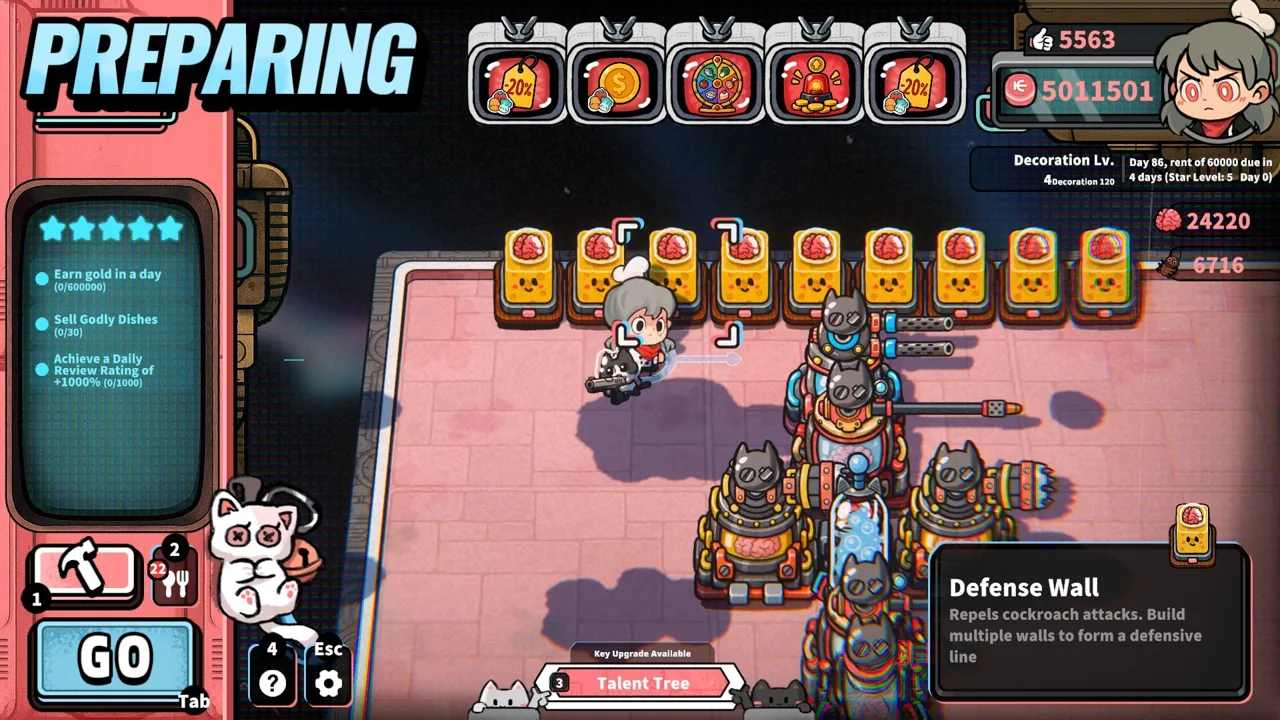 Image: Steam / GARRY
Use that short recipe to practice completing an order without unnecessary detours.
| Step | Leafy Salad action | Detail to remember |
|---|---|---|
| Take the order | Approach the seated customer | Identify who requested the salad |
| Collect the ingredient | Pick up a Leafy Folk | Start at the matching container |
| Prepare the food | Place it on the Cutting Counter and slice it | Complete the cutting step |
| Plate the salad | Pick up the sliced ingredient and plate it | Bring the prepared ingredient to plating |
| Deliver the dish | Carry the plate to the customer | Return to the customer who ordered it |
The early service also introduces Potato Salad. Read its recipe instructions before preparing it, especially when customers alternate between leafy and potato orders. Keep your attention on the requested dish rather than repeating the last ingredient you handled.
Keep the Customer Attached to the Dish
When several gods are seated, remembering “someone wanted salad” leaves too much room for confusion. Check the order display before picking up an ingredient and again before delivery if you have lost track.
Practice with a simple mental sequence:
- Identify the customer and requested recipe.
- Collect the matching ingredient.
- Complete its preparation.
- Plate the food.
- Deliver it to that customer.
The plate interaction menu in the early-development tutorial includes taking out plates, putting them back, and washing plates. Familiarize yourself with those actions while learning the kitchen routine. If you are struggling at the plate area, check the available interaction before heading back to the ingredient container.
Life, the Universe, and Restaurants plating becomes easier to manage when each action has a clear purpose. Finish the ingredient’s preparation, use the relevant plate interaction, and keep the customer’s order in mind through delivery.
Arrange Your Kitchen Around the Serving Route
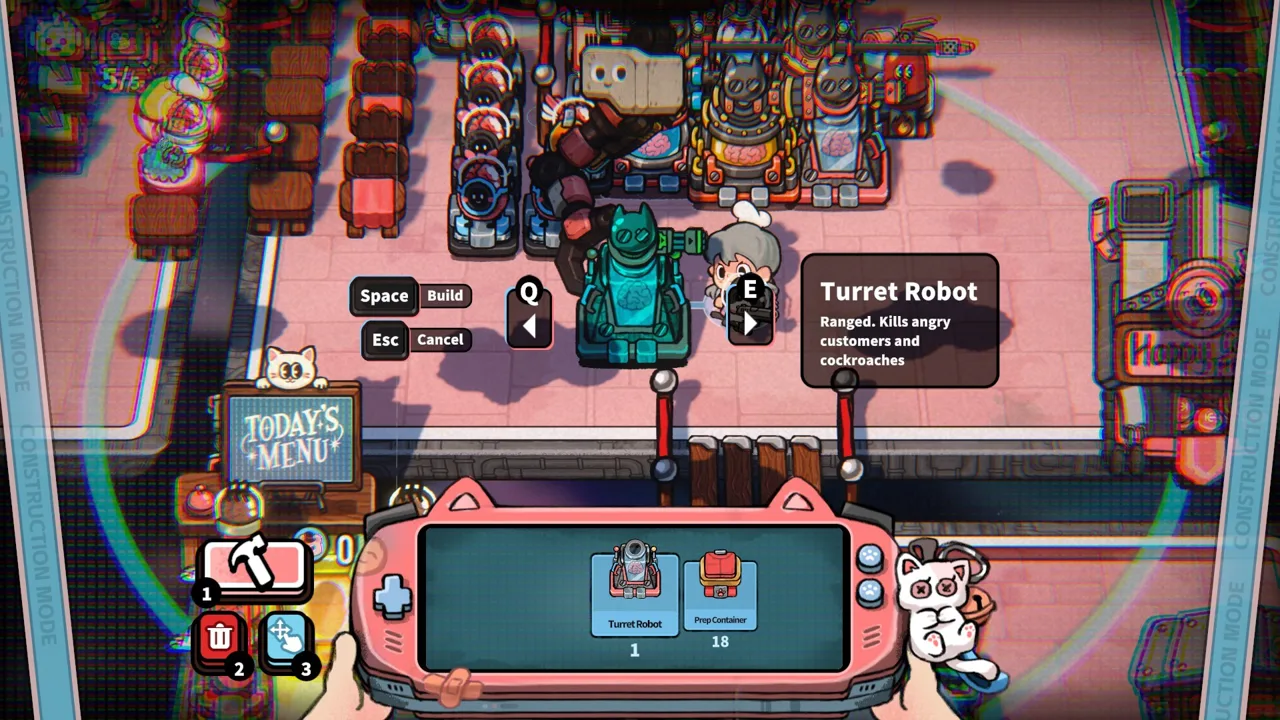
Your restaurant layout determines how much movement sits between each cooking action. The game lets you place production facilities, expand onto additional plots, and refine traffic flow as the restaurant grows.
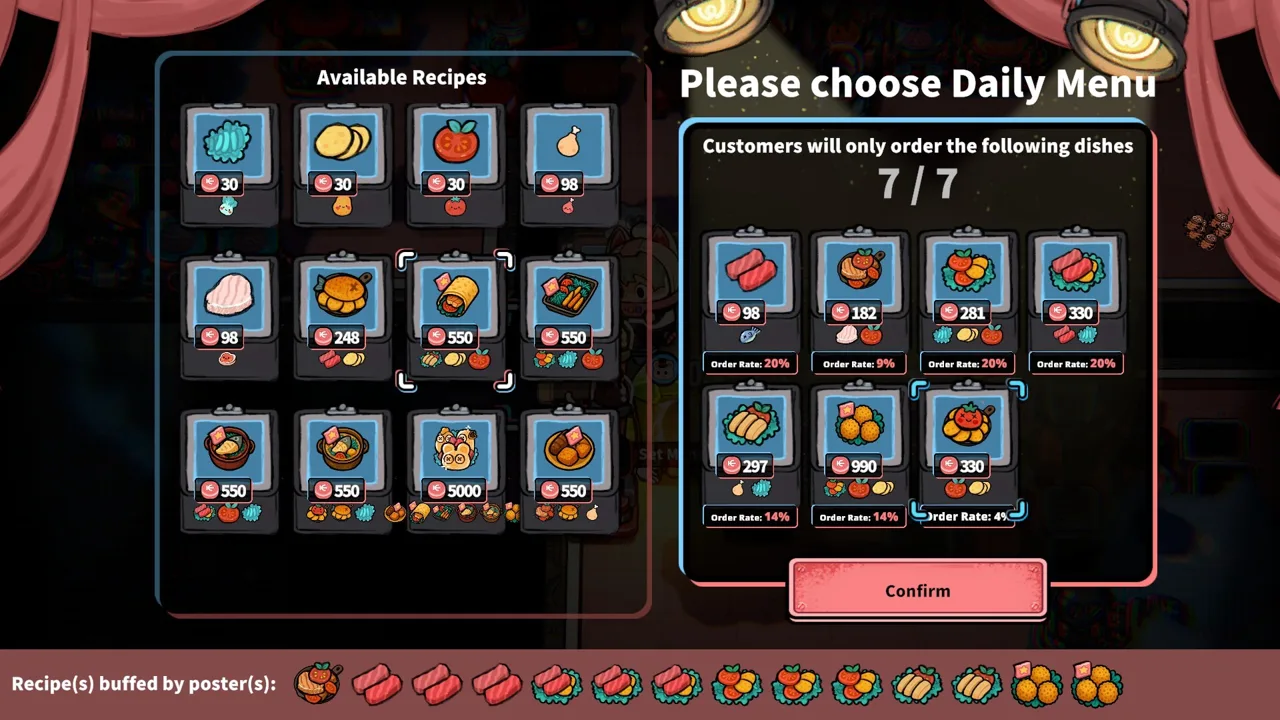 Image: Steam / GARRY
Start by following one recipe’s route through your kitchen. Look at the distance from its ingredient container to the processing station, then from processing to plating, and finally from plating to the Customer Tables.
Keep those connections convenient. Leave enough space to move between the facilities you use repeatedly.
| Kitchen connection | What travels along it | Layout tip |
|---|---|---|
| Ingredient container to Cutting Counter | An ingredient awaiting preparation | Keep frequently used ingredients near processing |
| Processing station to plating area | Prepared food | Shorten the trip between consecutive recipe steps |
| Plating area to Customer Tables | Finished dishes | Preserve a clear delivery route |
| Dining area to Vault | Collected Coins | Make deposits convenient without stretching the cooking route |
Coins add another trip to your workload. After service, gods throw them onto the ground. Moving close collects them onto your back, but you must transport them to the Vault to actually obtain them.
Plan that deposit route alongside your serving route. Collect nearby Coins when the order queue gives you room, and avoid repeatedly interrupting a dish halfway through preparation.
Watch Trash Bin Placement
Nearby Trash Bins reduce customer patience. The game also uses customer anger as part of its combat and Brain-harvesting systems, so bin placement has consequences beyond kitchen convenience.
When focusing on timely service, keep patience-reducing placement in mind around Customer Tables. Handle objectives involving Trash Bins deliberately rather than treating every dining area as interchangeable.
For Life, the Universe, and Restaurants plating, inspect the route on both sides of the plate. If preparation is nearby but delivery requires a long trip, reconsider where the finished dish leaves the kitchen.
Build Robot Routines That Reach the Table
Robots can repeat a recorded cooking routine continuously. They can also take orders, serve dishes, transport Coins, and clean up. As you unlock recipes with more preparation steps, multiple Cooking Robots can work together in sequence.
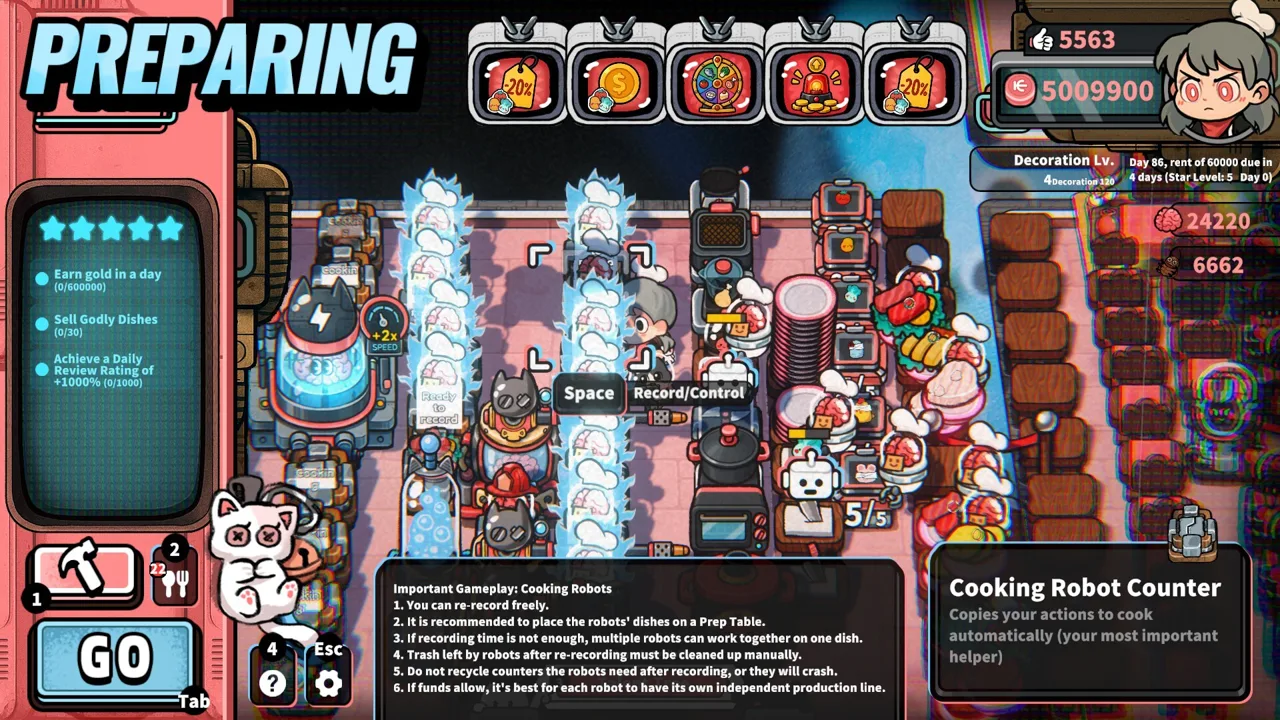 Image: Steam / GARRY
Before recording, perform the intended routine manually. Keep the route direct and the actions focused on the job you want repeated.
If the routine includes plating, carry the prepared ingredient through that step. If it also includes serving, complete delivery as part of the intended sequence. Give each robot a clearly defined role when dividing work across several machines.
| Robot task | Work described by the game | What to check during operation |
|---|---|---|
| Taking orders | Handles customer orders | Whether orders are being taken as customers arrive |
| Cooking | Repeats recorded cooking actions | Whether the intended preparation sequence is completed |
| Serving | Delivers dishes | Whether finished food reaches customers |
| Transporting Coins | Moves restaurant earnings | Whether Coins reach the Vault |
| Cleaning | Handles cleanup work | Whether cleaning keeps pace with service |
Practice Complex Recipes Before Recording
Longer recipes demand more preparation actions. Practice those actions in order before recording, and remove avoidable travel from the route.
For a recipe handled by multiple Cooking Robots, map the sequence before assigning jobs. Decide which preparation work belongs to each robot and where plating enters the process. Then watch the routine operate through to its intended endpoint.
Use Life, the Universe, and Restaurants plating as a checkpoint when reviewing automation. Follow the food from preparation to the plate, then follow the finished dish to service. That gives you a concrete way to spot which part of the workflow needs attention.
Keep these checks focused:
- Watch the complete routine before expanding it.
- Check that preparation reaches its intended endpoint.
- Include plating in the appropriate robot’s job.
- Follow serving separately when another robot handles delivery.
- Check Coin transport alongside kitchen performance.
Automation expands what your restaurant can handle, but each repeated action still belongs to a larger service sequence. Build that sequence carefully before adding more demand.
Match Your Menu to Your Kitchen’s Capacity
Progression takes your restaurant from 1 Star toward 5 Stars by completing business objectives. Higher Star Ratings unlock additional recipes, structures, robots, plots, ads, talents, and management systems.
More complex dishes bring longer preparation sequences. More Customer Tables increase the scale of service. Keep checking the cooking and plating workflow as those changes arrive.
Advertising also affects demand. Posters make customers more likely to order particular dishes, while TVs steer them toward a selected menu. Dish prices, order rates, serving speed, and automation efficiency all contribute to your business strategy.
| Management system | Its role | What to review in the kitchen |
|---|---|---|
| Posters | Encourage orders for particular dishes | The promoted dish’s preparation and plating route |
| TVs | Guide customers toward a selected menu | Capacity across the selected recipes |
| Additional Customer Tables | Expand customer seating | Delivery routes and serving workload |
| Higher-tier recipes | Introduce more complex preparation | Processing steps and robot assignments |
| Additional robots | Expand automated work | How consecutive jobs fit together |
Before promoting a dish, walk through its production sequence. Check ingredient pickup, processing, plating, and delivery. Give special attention to any step that already interrupts service.
For example, if you want to encourage Leafy Salad orders, review the route from the Leafy Folk container to the Cutting Counter and onward to plating. Then check how finished salads reach the tables. Keep the advertised dish’s entire journey in view.
Expand With a Specific Problem in Mind
Choose improvements around the work that needs attention:
- Rework the layout when travel between recipe steps becomes cumbersome.
- Assign robot help to repeatable cooking or service tasks.
- Review serving when finished dishes wait for delivery.
- Review Coin transport when deposits repeatedly pull you away from cooking.
- Revisit recipe assignments when longer preparation sequences enter the menu.
Keep Life, the Universe, and Restaurants plating in that review whenever your restaurant changes. A kitchen arranged for short salad recipes deserves another look when you introduce more elaborate dishes or increase seating.
The game is available for Windows through Life, the Universe, and Restaurants on Steam. Its restaurant systems give you plenty to manage, but keep your immediate focus concrete: prepare the requested food, plate it, deliver it, and get the earnings into the Vault.
FAQ
How does Life, the Universe, and Restaurants plating work?
Plating follows the recipe’s preparation steps. For Leafy Salad in the early-development tutorial, collect a Leafy Folk, slice it at the Cutting Counter, pick up the sliced ingredient, and plate it. Carry the finished dish to the customer who ordered it.
Can robots handle cooking and serving?
Yes. Robots repeat recorded routines and can perform cooking and serving work. They can also take orders, transport Coins, and clean up. More complex recipes can use multiple Cooking Robots working in sequence.
How do you collect money after serving customers?
Customers throw Coins onto the ground after being served. Move close to collect them onto your back, then transport them to the Vault. Depositing them there completes the collection process.
Why do customers lose patience near Trash Bins?
Nearby Trash Bins reduce customer patience. When gods exhaust their patience, they can become aggressive. Consider that effect when arranging Customer Tables and when completing objectives that involve placing bins around diners.
Continue with
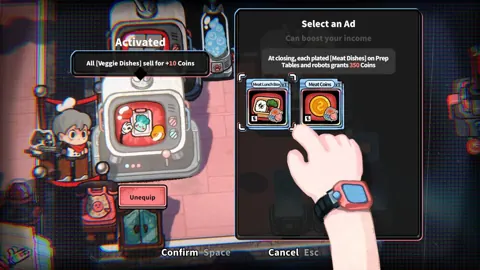 Life, the Universe, and Restaurants Recipes ExplainedMaster Life, the Universe, and Restaurants recipes with salad steps, kitchen layout tips, robot automation, and menu strategies for smoother daily service.
More in Restaurant
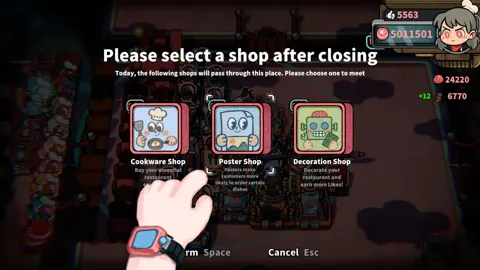
Life, the Universe, and Restaurants Coin Collection Guide
Master Life, the Universe, and Restaurants coin collection with vault routes, transport robots, ad strategies, and practical tips to grow daily income.
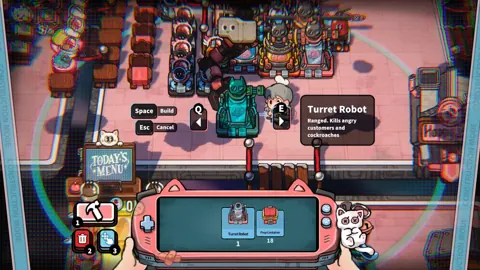
Life, the Universe, and Restaurants Commercials Guide
Life, the Universe, and Restaurants commercials boost dish income and shape your menu. Learn how to use TVs, posters, and robots to earn more during shifts.
Life, the Universe, and Restaurants Customer Attacks: Guide
Life, the Universe, and Restaurants customer attacks turn angry gods into Brains. Learn patience triggers, defense options, and smarter robot strategies.
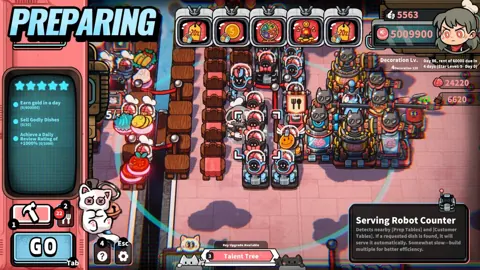
Life, the Universe, and Restaurants Customer Patience: Tips
Master Life, the Universe, and Restaurants customer patience: serve faster, manage trash bins, harvest brains, and build robots to keep service moving.
Join the community
Official channels for news, updates and player help: