
Life, the Universe, and Restaurants Dish Skill Trees Guide
Explore Life, the Universe, and Restaurants dish skill trees, boost dish value, and plan menus, ads, and robot workflows for a more profitable kitchen.
Jump to
How Dish Skill Trees Fit Your Restaurant
A valuable recipe deserves a kitchen that can keep up, and Life, the Universe, and Restaurants dish skill trees let you increase the value of individual dishes. Planning your Life, the Universe, and Restaurants dish skill trees matters because your menu, advertising, and robot routines all feed into the same business. Build those systems together, and you can pursue higher revenue while keeping service moving.
Your restaurant serves customers who call themselves gods, but their orders still require real work. You gather ingredients, process them, plate the food, and carry finished dishes to tables. As the restaurant grows, more complicated recipes enter the picture, alongside robots that can repeat recorded cooking routines.
Life, the Universe, and Restaurants dish skill trees give that cooking loop a longer-term direction. Each dish has a dedicated tree for increasing its value, letting you develop particular recipes as part of your restaurant strategy.
Keep the different progression systems straight:
| System | What it does | Connection to your menu |
|---|---|---|
| Dish skill trees | Increase individual dish value | Develop recipes you intend to serve |
| Recipe unlocks | Add dishes, including recipes with more complex preparation | Expand your cooking options |
| Restaurant Star Rating | Opens access to more recipes, structures, robots, talents, and management systems | Broadens your business options |
| Advertising | Influences orders and can increase profits from specific dishes | Supports featured dishes |
| Brain-based progression | Upgrades talents and unlocks more powerful brain-based robots | Supports the wider restaurant operation |
The overall objective is to move your restaurant from one star to five stars by completing business objectives at each stage. Keep those objectives in view when choosing what to develop next.
Before investing attention in a recipe, walk through its entire preparation route. Identify the ingredients, workstations, plating step, and trip to the customer. That gives you a practical foundation for deciding which dishes deserve a larger role on your menu.
Choose a Dish Strategy Before Expanding Your Menu
With Life, the Universe, and Restaurants dish skill trees, the useful question is which dish you want your restaurant to produce consistently. A recipe’s increased value becomes more useful when customers order it and your kitchen can deliver it.
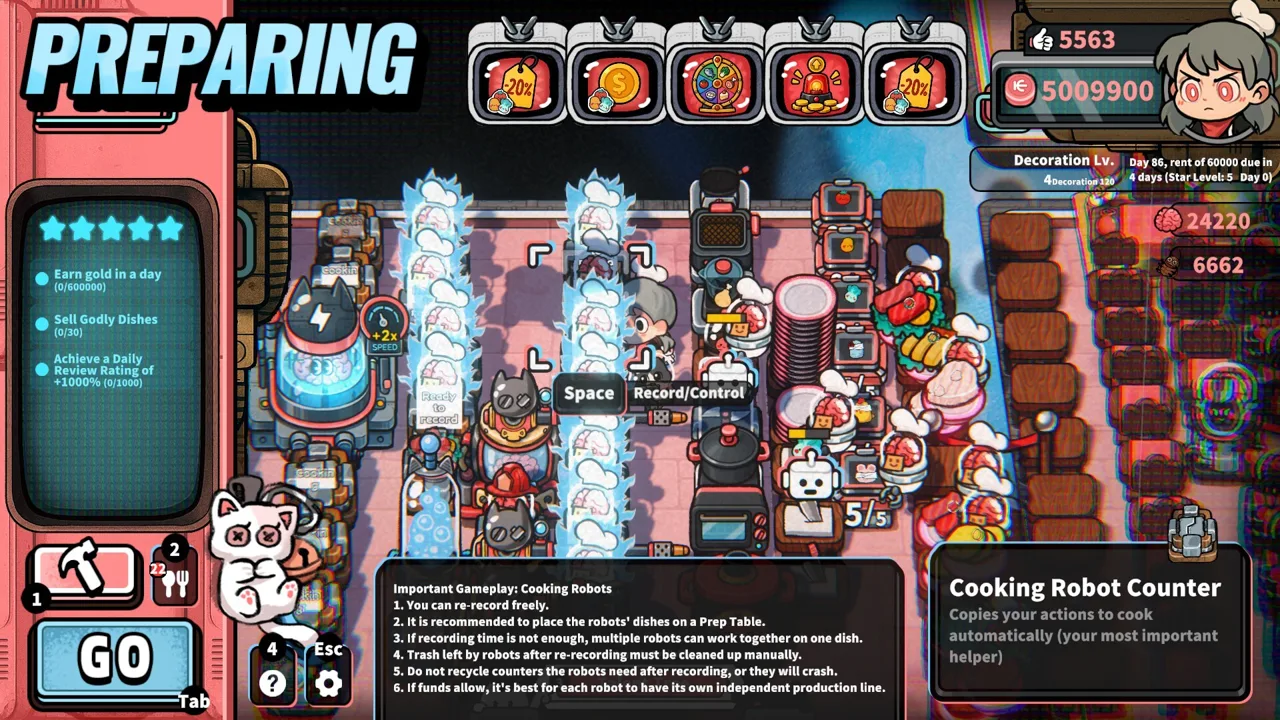 Image: Steam / GARRY
The game supports several business directions: promoting the same dish across multiple days, rotating your menu, or specializing in Veggie Dishes or Meat Dishes. Choose a direction that matches your current facilities and workload.
Early cooking includes Leafy Salad and Potato Salad. The Leafy Salad routine introduces a straightforward sequence: collect a Leafy Folk, slice it at the cutting counter, plate it, and serve it. Higher-tier recipes add increasingly complex preparation, which creates more work to coordinate.
Compare your menu plans through their operational requirements:
| Menu direction | What to examine | Planning tip |
|---|---|---|
| Repeated featured dish | Its full preparation route and available advertising | Develop the cooking routine before pushing more orders |
| Rotating menu | The stations and ingredients required by each selected dish | Check the kitchen setup before changing your focus |
| Veggie Dishes | The vegetable recipes your restaurant has unlocked | Coordinate recipe development with your chosen specialty |
| Meat Dishes | Preparation complexity and robot coordination | Break longer workflows into manageable jobs |
Match dish development to dishes you actually intend to serve. Keep your current menu beside your upgrade decisions so that your cooking plan and investment plan point in the same direction.
Avoid expanding everything at once. More tables create room for customers, but those customers still need orders taken and meals delivered. More recipes create variety, but they also bring additional preparation demands.
Before adding another production task, watch a service period and identify where you spend your time. Are you constantly chopping? Carrying plates across the room? Leaving the kitchen to collect Coins? Use that workload to guide your next change.
For example, if Leafy Salad already has a compact preparation route, consider building your featured menu around that established routine. If you want to shift toward more complicated dishes, prepare the necessary facilities and robot jobs alongside that shift.
Connect Dish Value With Advertising and Prices
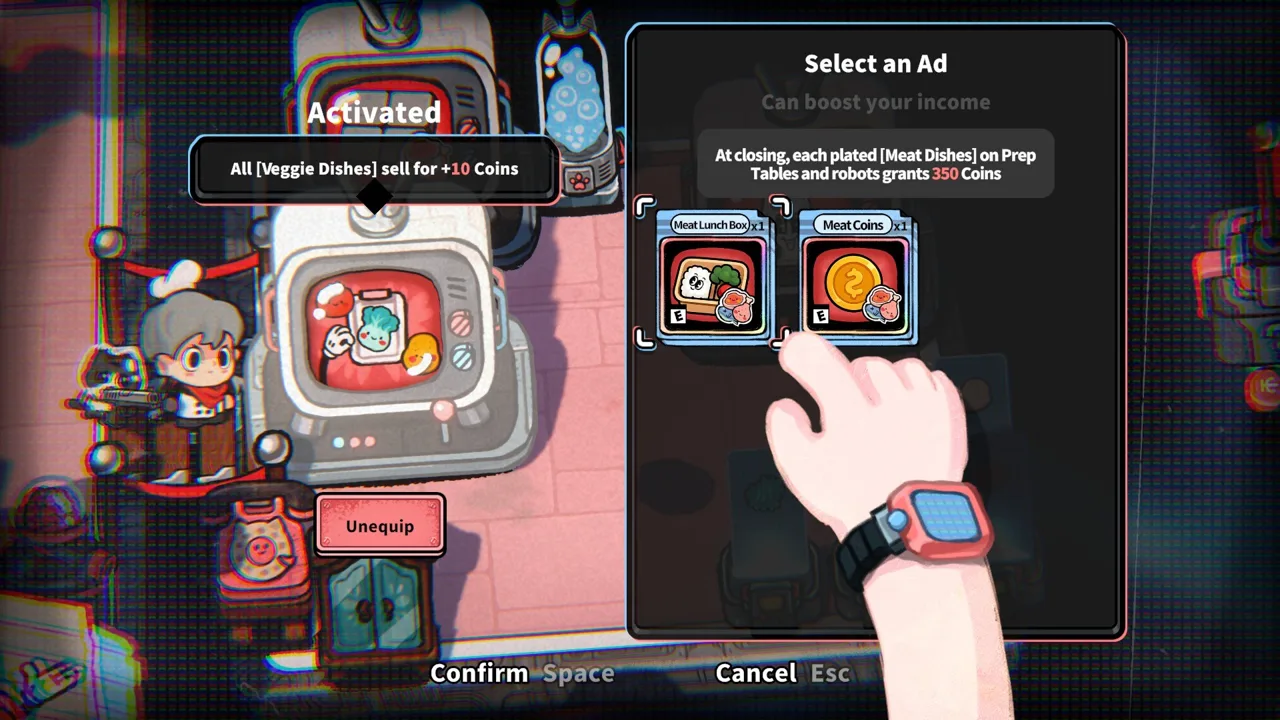 Image: Steam / GARRY
Life, the Universe, and Restaurants dish skill trees fit into a broader business strategy built around dish prices, order rates, serving speed, and automation efficiency. Increasing dish value is one part of that strategy; influencing what customers order is another.
Posters make customers more likely to choose particular dishes. TVs steer them toward a selected menu. Different ads can also increase profits from specific dishes, giving you ways to connect your restaurant’s promotions with its cooking focus.
Align those choices deliberately:
| Business element | Supported function | Action to take |
|---|---|---|
| Dish skill tree | Increases a dish’s value | Develop a recipe that fits your menu plan |
| Poster | Makes a particular dish more likely to be ordered | Feature a dish your kitchen can produce reliably |
| TV | Guides customers toward a selected menu | Coordinate the selection with your production setup |
| Ads | Can increase profits from specific dishes | Match advertising to the dishes you are developing |
| Pricing strategy | Can use queue length, Coin balance, and special events | Revisit pricing alongside your operating conditions |
Start with the kitchen’s output, then shape demand around it. Promoting a dish creates more reason to prepare that dish, so check its workflow before directing customers toward it.
Picture a restaurant focused on one developed recipe. Its dish tree supports value, its Poster supports ordering, and its cooking routine supports production. Keep those elements aligned rather than promoting a recipe that sends you racing between distant stations.
The game also lets you build strategies around your current Coin balance, queue length, and special events to push prices higher. Use those systems as part of your broader menu plan, and keep serving speed in the calculation.
Remember that earning Coins includes a transport job. Customers drop Coins after dining, and you must carry those Coins to the vault to obtain them. Robots can handle Coin transport, so include that task when planning automation.
During manual service, fit collection trips around your cooking route. Before spending on expansion or another promotion, check the money already deposited in your vault and the expenses your restaurant needs to cover.
A valuable menu still needs a functioning business behind it.
Build Robot Workflows Around Your Featured Dishes
A dish upgrade has practical value when the restaurant can keep serving that dish. Pair Life, the Universe, and Restaurants dish skill trees with robot workflows that support your chosen menu.
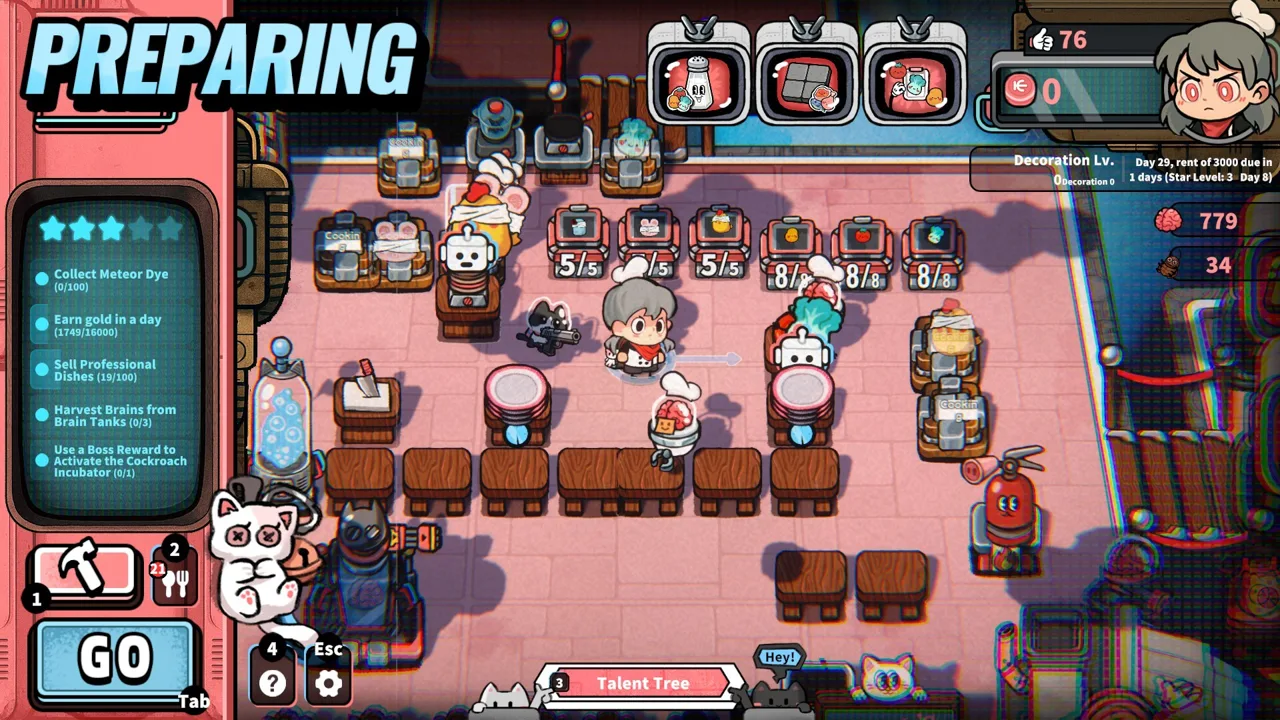 Image: Steam / GARRY
Robots learn by recording your routine and repeating it. Their jobs extend beyond cooking: they can take orders, serve meals, transport Coins, and clean up. That gives you several ways to reduce the tasks competing for your attention.
Higher-tier recipes involve more complex preparation. Multiple Cooking Robots can work together in sequence, allowing you to organize a production line around those additional steps.
Use this planning sequence when developing automation:
| Planning step | What to examine | What to do |
|---|---|---|
| Trace the recipe | Ingredients, processing, plating, and serving | Walk through the complete dish routine |
| Review the layout | Travel between required stations and tables | Arrange facilities around the work they support |
| Record the routine | The actions the robot will repeat | Demonstrate the intended job clearly |
| Coordinate Cooking Robots | The sequence of preparation tasks | Give each robot a defined role in the process |
| Include support work | Orders, serving, Coin transport, and cleaning | Allocate robot help beyond food preparation |
Keep the physical route compact where your layout allows it. Place facilities with the recipe sequence in mind, and leave room for movement between production and customer tables.
For a simple salad routine, think through the path from ingredient container to cutting counter, then to plating and service. For a more elaborate recipe, map the additional processing before assigning robot jobs.
After recording a routine, watch it operate during service. Check that ingredients reach the next stage, finished dishes move toward customers, and supporting work keeps pace. Refine the layout or task arrangement wherever the process stalls.
Be selective about adding tables. Expand customer capacity alongside production capacity, serving support, and Coin collection. Use your Star Upgrade objectives to organize that expansion instead of treating every new structure as an immediate priority.
When your menu changes, review the automation supporting it. A restaurant built around a repeated featured dish has different preparation needs from one rotating among several recipes. Keep your robot routines connected to the food you are asking customers to order.
Keep Dish Development Connected to Star Progression
Your Life, the Universe, and Restaurants dish skill trees belong inside the larger push toward a five-star restaurant. Completing stage objectives raises your Star Rating, which opens more purchasable plots, recipes, structures, robots, ads, talents, and management systems.
Use each stage to reassess the restaurant as a whole. Check whether the next objective calls for broader facilities, more effective production, or a different use of your existing systems.
Before changing your business plan, review these questions:
- Which dishes are you developing and serving?
- Does your advertising support those dishes?
- Can your current kitchen handle their preparation?
- Which jobs are still pulling you away from cooking?
- What business objectives are needed for your next Star Upgrade?
The restaurant’s darker systems also matter. Trash Bins, lighting, and other methods can reduce customer patience. Enraged customers become a combat problem, while harvested Brains can upgrade talents and unlock more powerful brain-based robots.
Keep Brain acquisition connected to your defense plan. The game includes Turret Robots, Guards, and other Defense Facilities for protecting the restaurant. Prepare those systems before deliberately using patience-draining methods to provoke customers.
Keep routine dining areas focused on the service strategy you want to run. If you are concentrating on preparing and delivering a featured dish, account for nearby Trash Bins and their effect on customer patience.
For your next service, choose one clear menu goal. Coordinate its dish development, promotion, workstations, and robot jobs. After service, review the workload and your remaining stage objectives before making another expansion decision.
You can explore the game’s Windows version through the Life, the Universe, and Restaurants Steam page.
FAQ
What do Life, the Universe, and Restaurants dish skill trees do?
They provide dedicated progression for individual dishes and increase their value. Connect that development with your menu, advertising, and cooking routines so the restaurant is prepared to serve the dishes you choose to emphasize.
How do you unlock more recipes?
Recipes become available through restaurant progression, with higher Star Ratings opening more recipe options alongside additional structures, robots, ads, and management systems. Complete the business objectives at each stage to advance toward five stars.
Can robots prepare complex dishes?
Yes. Robots repeat recorded cooking routines, and multiple Cooking Robots can work together in sequence on more complicated recipes. Map the preparation process and organize their jobs around each stage of the dish.
How do you encourage customers to order a developed dish?
Use Posters to make particular dishes more likely to be ordered, or TVs to guide customers toward a selected menu. Coordinate those promotions with your kitchen’s production capacity and the recipes you are developing.
Continue with
 Life, the Universe, and Restaurants Earning Likes GuideLife, the Universe, and Restaurants earning likes guide: learn how dining rewards work, manage customer patience, and work toward your 30-like objective.
More in Restaurant
Life, the Universe, and Restaurants Coin Collection Guide
Master Life, the Universe, and Restaurants coin collection with vault routes, transport robots, ad strategies, and practical tips to grow daily income.
Life, the Universe, and Restaurants Commercials Guide
Life, the Universe, and Restaurants commercials boost dish income and shape your menu. Learn how to use TVs, posters, and robots to earn more during shifts.
Life, the Universe, and Restaurants Customer Attacks: Guide
Life, the Universe, and Restaurants customer attacks turn angry gods into Brains. Learn patience triggers, defense options, and smarter robot strategies.
Life, the Universe, and Restaurants Customer Patience: Tips
Master Life, the Universe, and Restaurants customer patience: serve faster, manage trash bins, harvest brains, and build robots to keep service moving.
Join the community
Official channels for news, updates and player help: