
Life, the Universe, and Restaurants Recipes Explained
Master Life, the Universe, and Restaurants recipes with salad steps, kitchen layout tips, robot automation, and menu strategies for smoother daily service.
Jump to
Start With Salads and Learn the Cooking Loop
A hungry god is waiting, and your kitchen has to deliver. Learning Life, the Universe, and Restaurants recipes helps you keep orders moving while leaving time to collect earnings and manage your restaurant. This guide to Life, the Universe, and Restaurants recipes starts with the opening salads, then explains how recipe progression, kitchen placement, and robot automation fit together.
Cooking begins as a hands-on job. You take an order, gather the ingredient, process it, plate the dish, and carry it to the customer. Those individual actions are straightforward; the pressure comes from repeating them while more customers arrive.
The early-development opening menu includes Leafy salad and Potato salad. Both introduce the ingredient-to-counter-to-plate routine that your restaurant will build around.
| Opening recipe | Ingredient container | Preparation shown in the early-development build | Finishing steps |
|---|---|---|---|
| Leafy salad | Leafy folk container | Slice the Leafy folk at the cutting counter | Plate the sliced ingredient and serve |
| Potato salad | Potato folk container | Chop the Potato folk at the cutting counter | Plate the prepared ingredient and serve |
How to Make Leafy Salad
The opening tutorial walks you through this sequence:
- Take the seated customer's order.
- Pick up a Leafy folk from its container.
- Place it on the cutting counter and slice it.
- Pick up the sliced ingredient and plate it.
- Carry the plate to the customer who ordered it.
Keep the correct order in mind when you leave the kitchen. During a busy service, several tables can need attention at once, and remembering which customer requested which dish saves you from wandering between tables with a finished plate.
How to Make Potato Salad
In the early-development opening service, Potato salad follows a similarly compact routine: collect the Potato folk, chop it at the cutting counter, plate it, and deliver it.
Practice both salads before expanding your workload. Focus on finding the correct container quickly and moving directly through preparation and plating. These simple recipes give you room to learn the restaurant's rhythm without juggling the increasingly complex preparation that comes later.
Life, the Universe, and Restaurants recipes also sit inside a larger service loop. After eating, customers throw Coins onto the ground. Walking near those Coins collects them onto your back, but you must transport them to the vault to obtain them. Include that trip in your service routine so finished orders translate into money you can use.
Unlock Recipes Through Restaurant Progression
Your overall goal is to complete business objectives and raise the restaurant from 1 Star to 5 Stars. Recipes are part of that progression, alongside cookware, structures, robots, additional plots, advertising, talents, and management systems.
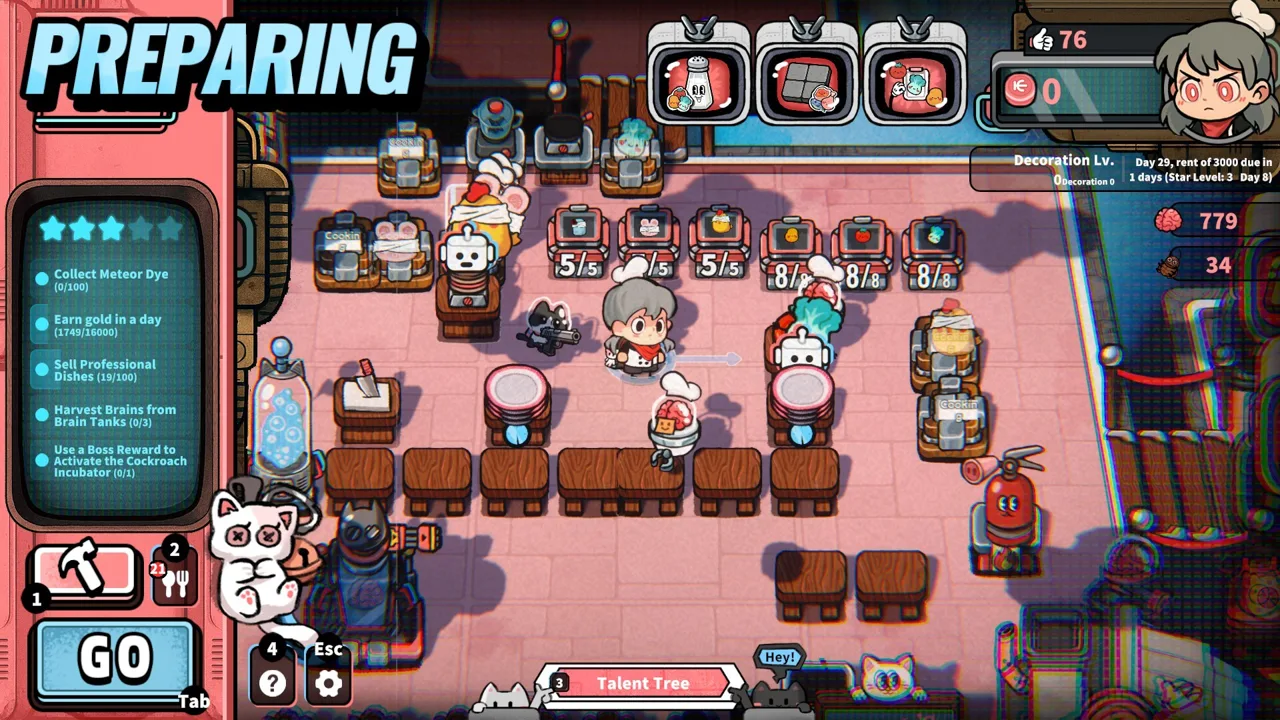 Image: Steam / GARRY
Higher-tier recipes introduce more complex preparation. As your menu develops, the kitchen needs enough equipment and staff to handle the extra work. Unlocking a dish and producing it efficiently are separate challenges.
| Progression element | What it adds | What to check before expanding |
|---|---|---|
| Star Rating | Access to more recipes and restaurant systems | Current stage objectives |
| Recipe unlocks | Additional dishes with increasingly complex preparation | Required cooking sequence |
| Cookware and production facilities | Equipment for preparing dishes | Placement along the cooking route |
| Additional plots | Space to expand the restaurant | Kitchen capacity and customer traffic |
| Robot staff | Help with cooking and other service jobs | Which task currently slows service |
Check your current objectives before spending on expansion. The game asks you to complete the business tasks for each stage, so aim your purchases at those requirements and the work your kitchen needs to perform.
When choosing how to handle new Life, the Universe, and Restaurants recipes, trace the complete preparation sequence before changing the menu. Identify the ingredient pickup, processing actions, plating location, and delivery route. Then arrange the required equipment around that sequence.
Avoid adding customer tables while the existing kitchen is already struggling to keep up. More seating expands service demands; it also gives you more orders to prepare, plates to deliver, and earnings to move. Increase production capacity alongside the dining room.
Keep earning Coins through service, and use them to support recipe development, cookware purchases, and expansion. A larger restaurant needs a workable cooking process just as much as it needs floor space.
Arrange the Kitchen Around Each Recipe
The layout determines how much travel sits between an order and a finished meal. Cooking already requires repeated trips between ingredient containers, preparation stations, and Customer Tables. Give those trips a clear purpose.
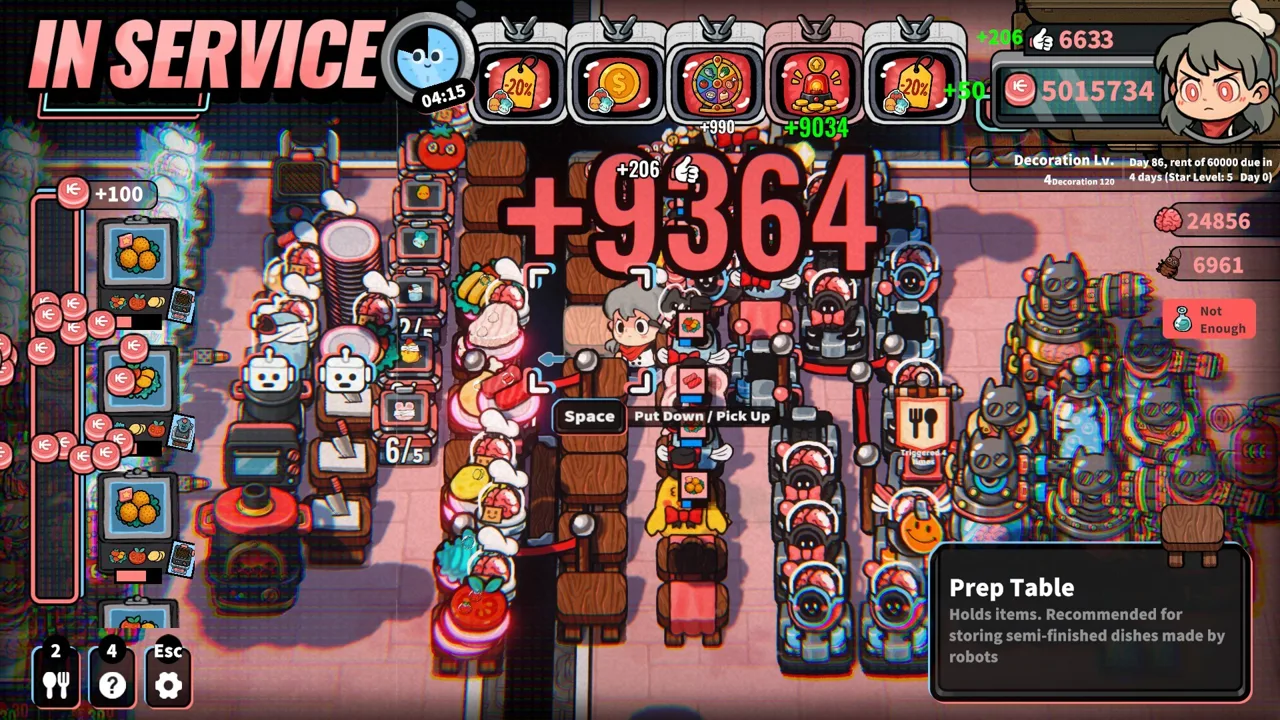 Image: Steam / GARRY
For the opening salads, arrange your workspace around this sequence:
Ingredient container → cutting counter → plating → Customer Table
This is a suggested layout sequence based on the cooking actions, rather than a fixed building arrangement. Place the stations so you can follow the recipe without repeatedly crossing the restaurant.
Keep both salad ingredients convenient to the cutting counter. Place the plating area where it fits naturally after chopping, then preserve a practical route toward the dining tables. Remember that the same space must also support coin collection and trips to the vault.
Before opening service, walk through the route you intend to use. Check whether you can move between each station without taking an unnecessary detour. Make those adjustments while you can focus on placement instead of customer orders.
Balance Cooking With the Rest of Service
Preparing Life, the Universe, and Restaurants recipes is only one demand on your time. You also need to take orders, deliver food, move Coins, and handle cleanup.
Use these checks to spot where the restaurant needs attention:
- Orders are waiting to be taken: Focus on customer interaction or assign that work to a robot when available.
- Ingredients take too much travel: Move their containers closer to the preparation route.
- Finished dishes wait in the kitchen: Give serving more attention or assign a serving robot.
- Coin collection interrupts cooking: Include vault trips in your route or use robot transport.
- Customers lose patience near trash bins: Reconsider bin placement around tables.
Trash Bins have a special consequence in this game: placing them near customers reduces patience. Lighting and other methods can also drain patience, leading to enraged guests.
Keep that system in mind when arranging a restaurant intended for steady meal service. Brain collection is another business strategy, but mixing it casually into your dining layout creates a different kind of workload.
Teach Robots to Handle Recipe Preparation
Robots can take orders, cook, serve dishes, transport Coins, and clean up. Their cooking system uses recorded routines: demonstrate the work, and the robots repeat it.
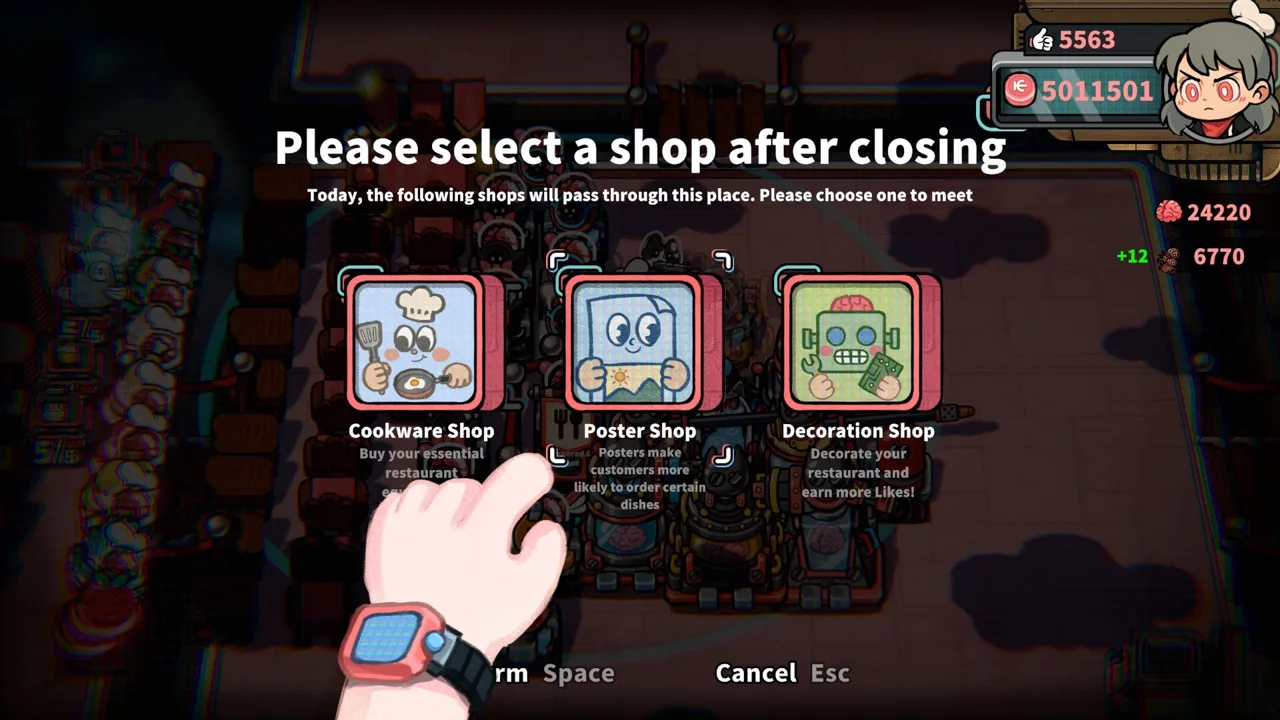 Image: Steam / GARRY
That makes preparation planning especially useful. A cooking routine includes the actions needed to produce the dish, so organize the kitchen before teaching those actions. Practice the route manually until you can follow it without searching for ingredients or retracing your steps.
| Robot task | Work it handles | How to prepare the restaurant |
|---|---|---|
| Taking orders | Customer order collection | Organize the dining area for service |
| Cooking | Repetition of recorded cooking routines | Arrange ingredients and equipment in preparation order |
| Serving | Delivery of finished dishes | Keep a practical route between kitchen and tables |
| Coin transport | Movement of earnings | Include the vault in the transport layout |
| Cleanup | Cleaning duties | Consider cleanup alongside food production |
Start with the task that interrupts you most often. If collecting Coins repeatedly pulls you away from chopping, assign transport help. If dishes are ready but customers are still waiting, focus on serving. Let the restaurant's actual workload guide your next assignment.
Split Complex Cooking Into a Sequence
Higher-tier Life, the Universe, and Restaurants recipes support a more elaborate automation setup. Multiple Cooking Robots can work together in sequence, turning preparation into a production line.
Plan each stage around what the next robot needs. Follow the recipe's required actions and arrange the equipment to support those handoffs. Keep ingredient preparation, later processing, and finishing organized in the same order as the dish itself.
Watch the complete routine after assigning it. Check that ingredients reach preparation, that processing finishes, and that plated food reaches customers. Then address the point where work starts waiting.
Robots also connect to the game's darker management systems. Brains harvested from enraged customers support talent upgrades and access to more powerful brain-based robots. Those customers can attack restaurant facilities, and defense options include Turret Robots, Guards, and other Defense Facilities.
Plan defense alongside any strategy that deliberately drains customer patience. Cooking automation and customer aggression both affect the restaurant, so account for the extra demands before pursuing Brain collection.
Build a Menu Your Kitchen Can Support
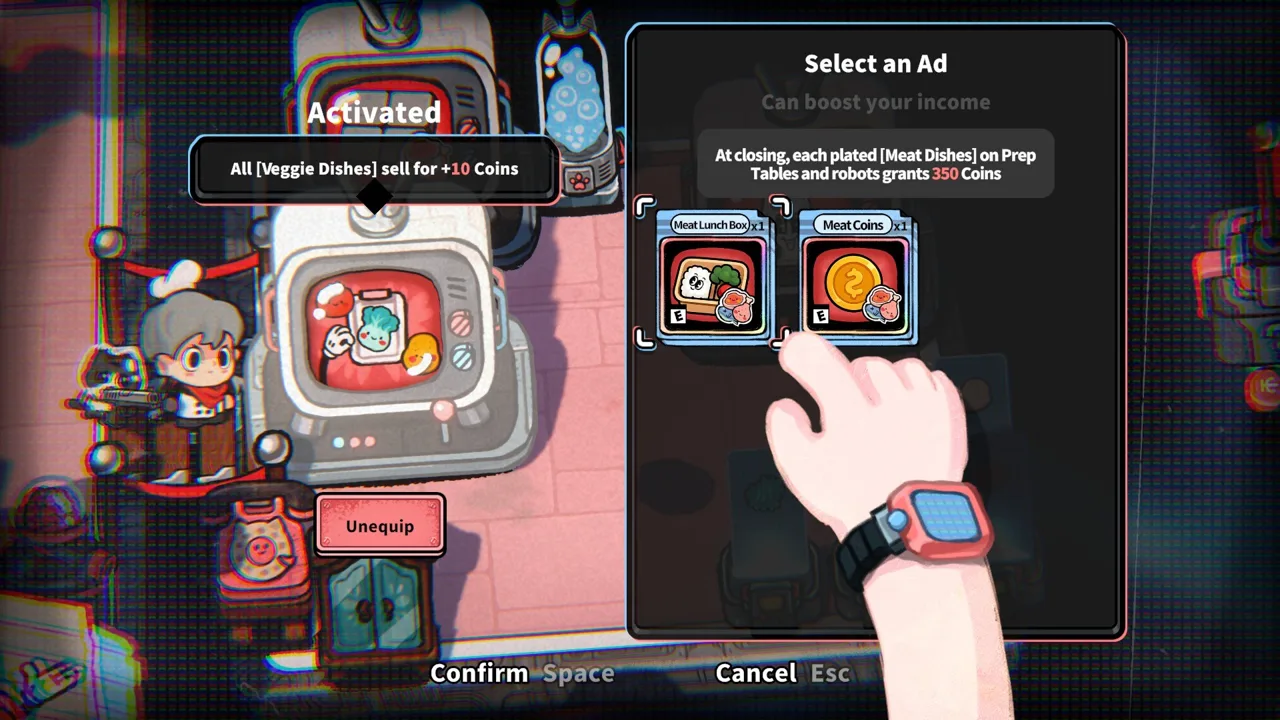
Life, the Universe, and Restaurants recipes work together with pricing, advertising, order rates, and automation efficiency. You can promote the same dish repeatedly, rotate your menu, or specialize in Veggie Dishes or Meat Dishes.
Posters make customers more likely to order particular dishes. TVs help steer customers toward a selected menu. Those tools let you influence demand, which makes kitchen capacity an essential part of your advertising decisions.
| Menu tool or strategy | Supported effect | Practical tip |
|---|---|---|
| Posters | Increase the likelihood of orders for particular dishes | Promote a dish your kitchen can produce steadily |
| TVs | Steer customers toward a selected menu | Choose dishes that fit your current production setup |
| Dish skill trees | Increase the value of individual dishes | Develop the dishes you intend to feature |
| Veggie or Meat specialization | Supports a focused business strategy | Organize equipment around your chosen dish category |
| Menu rotation | Changes your menu strategy over time | Review preparation demands before switching dishes |
Develop your featured dish's production routine before encouraging more customers to order it. Follow its preparation from ingredient pickup through delivery, then check whether another restaurant duty keeps interrupting the process.
Dish-specific skill trees let you increase a dish's value. Pair that development with a menu you can sustain. Keep serving speed and automation efficiency in view when deciding where to invest.
Review What Happens During Service
Use each service period to identify the next improvement. Notice whether you spend your time chopping, carrying plates, collecting Coins, or moving between distant stations. Adjust the layout or staff assignment around that workload.
When expanding your Life, the Universe, and Restaurants recipes menu, compare the new dish's preparation demands with the equipment and robots already available. Make room for its workflow before promoting it heavily.
If you are ready to run your own cosmic kitchen, play Life, the Universe, and Restaurants on Steam. Start by learning the salad routine, then build the cooking capacity to support your next recipe and restaurant upgrade.
FAQ
What are the starting Life, the Universe, and Restaurants recipes?
The early-development opening menu includes Leafy salad and Potato salad. Both use ingredients from their respective folk containers, preparation at a cutting counter, plating, and delivery to the customer.
How do you unlock more recipes?
Recipe access expands as your restaurant's Star Rating increases. Complete the business objectives for your current stage to progress toward the 5-Star goal, while developing cookware, production facilities, and robot staffing.
Can robots prepare food automatically?
Yes. Robots repeat recorded cooking routines. Higher-tier dishes can use multiple Cooking Robots working in sequence, and robots can also handle orders, serving, Coin transport, and cleanup.
How do you collect money after serving a dish?
Customers drop Coins after eating. Move near them to collect them onto your back, then carry them to the vault to obtain the earnings. Robots can also transport Coins.
Continue with
 Life, the Universe, and Restaurants Rent: Pay on TimeMaster Life, the Universe, and Restaurants rent with helpful tips for banking coins, boosting dish income, and building robots. Keep your kitchen earning.
More in Restaurant
Life, the Universe, and Restaurants Coin Collection Guide
Master Life, the Universe, and Restaurants coin collection with vault routes, transport robots, ad strategies, and practical tips to grow daily income.
Life, the Universe, and Restaurants Commercials Guide
Life, the Universe, and Restaurants commercials boost dish income and shape your menu. Learn how to use TVs, posters, and robots to earn more during shifts.
Life, the Universe, and Restaurants Customer Attacks: Guide
Life, the Universe, and Restaurants customer attacks turn angry gods into Brains. Learn patience triggers, defense options, and smarter robot strategies.
Life, the Universe, and Restaurants Customer Patience: Tips
Master Life, the Universe, and Restaurants customer patience: serve faster, manage trash bins, harvest brains, and build robots to keep service moving.
Join the community
Official channels for news, updates and player help: