
Coming soon · Release date: October 12, 2026 Steam store ↗
UpdatedLife, the Universe, and Restaurants demo: Steam Guide
Explore Life, the Universe, and Restaurants demo, check Steam details and PC requirements, and learn what to look for in its cosmic restaurant gameplay.
Jump to
Life, the Universe, and Restaurants Demo: What to Know
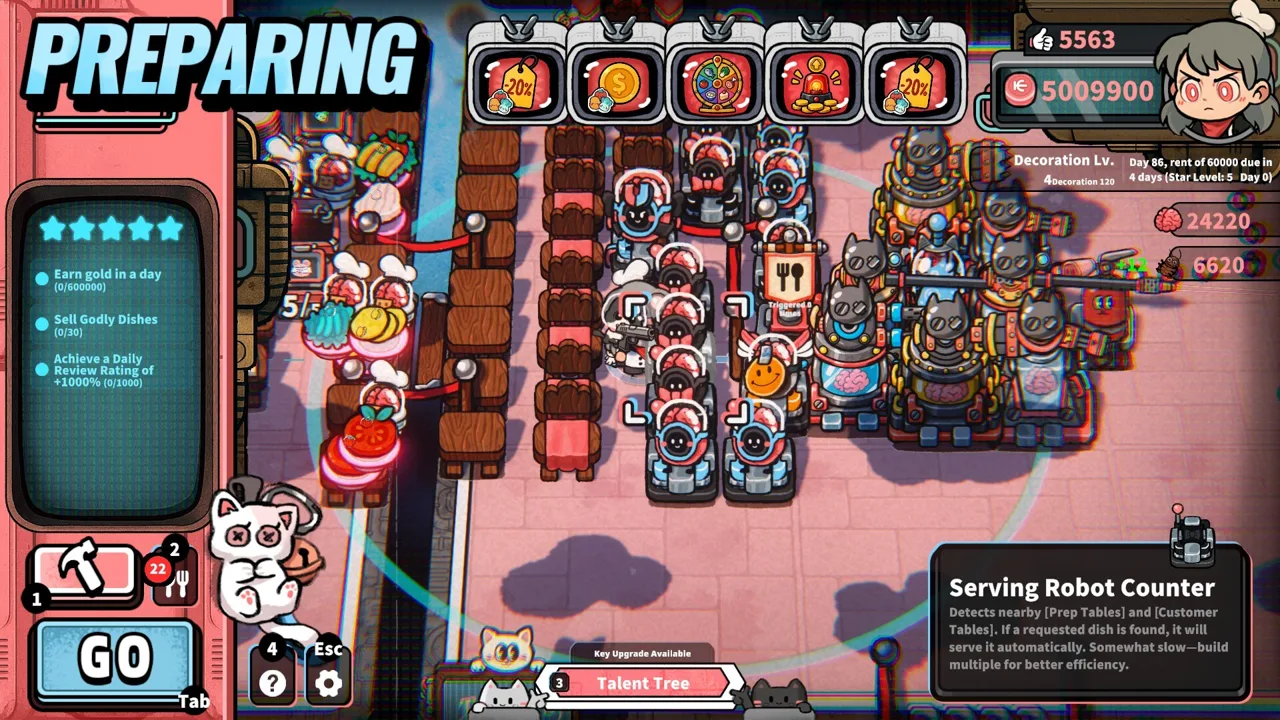
Dinner service gets complicated when your customers consider themselves gods and your kitchen staff runs on recorded routines. The Life, the Universe, and Restaurants demo is listed on Steam, giving interested players a starting point before the full game's scheduled October 12, 2026 release. Before you look for the Life, the Universe, and Restaurants demo, knowing which details are established—and which demo limits remain unspecified—can help you decide what to check.
Developed by GARRY and published by Gamersky Games, the game combines restaurant management, hands-on cooking, robot automation, and a darkly comic approach to customer service. You build a business in space, expand its facilities, and manage increasingly demanding patrons.
Here are the key listed details:
| Detail | Listed information |
|---|---|
| Full-game release date | October 12, 2026; still marked as coming soon |
| Main Steam app ID | 3746950 |
| Associated demo app ID | 4311130 |
| Listed platform | Windows |
| Developer | GARRY |
| Publisher | Gamersky Games |
| Game format | Single-player |
The demo has an associated Steam app, but its exact content, playtime, progression cap, and save-transfer rules are unspecified. The broader gameplay features discussed below describe the main game's store listing; their inclusion in the demo should not be assumed.
To check access, visit the Life, the Universe, and Restaurants Steam store page and look for its current demo offering. If an installation option is available, review any demo-specific information before downloading. A listed demo app alone does not establish that downloads are currently enabled.
Cooking and Robots: Understand the Restaurant Workflow
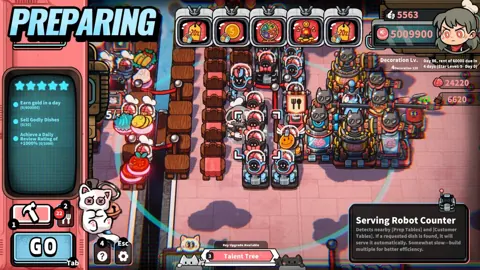
The central restaurant loop starts with manual work. You take orders, gather ingredients, prepare them, plate dishes, and deliver food to customer tables. That puts movement and preparation at the center of the experience: every trip across the restaurant competes with another task that needs attention.
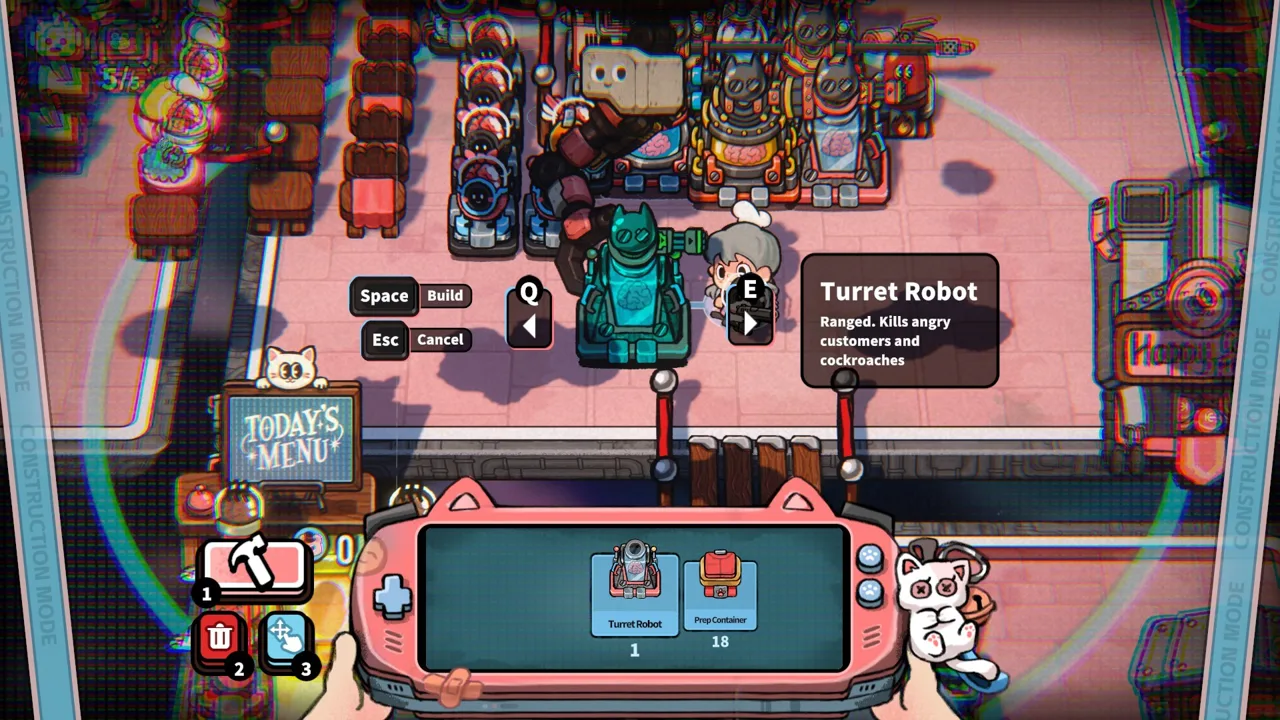 Image: Steam / GARRY
Automation changes how you handle that workload. The game lets you record a cooking routine and have robots repeat it. Robot staff can also handle orders, serving, coin transportation, and cleanup.
For anyone evaluating the Life, the Universe, and Restaurants demo, this relationship between manual work and automation is a useful focus if those systems are accessible. Watch how clearly the game communicates each task and how easy it is to understand what your robot staff is doing.
| Restaurant task | Described robot capability | Suggested point to evaluate |
|---|---|---|
| Taking orders | Robots can handle customer orders | Whether orders keep pace with kitchen production |
| Cooking | Robots repeat recorded cooking routines | Whether your routine includes unnecessary movement |
| Serving | Robots can deliver dishes | Whether finished food reaches tables efficiently |
| Moving Coins | Robots can transport Coins | How this task fits into your restaurant's workflow |
| Cleaning | Robots can clean up | Whether cleanup receives enough attention |
A good approach is to understand a recipe manually before recording its preparation. Because robots repeat your routine, practicing an efficient sequence gives you a clearer starting point for automation. Keep the relevant ingredients and cookware in mind when planning the route.
More advanced recipes introduce additional preparation steps. The main game describes arranging multiple Cooking Robots in sequence, turning individual tasks into a coordinated production line. That makes the handoff between stages worth watching.
For example, if preparation keeps moving but serving falls behind, adding more cooking capacity may fail to address the actual problem. As editorial advice, follow a dish from order to delivery and identify where work accumulates before changing your setup.
If the demo includes robot recording, consider these questions during play:
- Can you understand the routine you are teaching?
- Does the restaurant layout support that routine?
- Are cooking, serving, and cleanup receiving balanced attention?
- Can you identify which stage is slowing down orders?
These checks follow directly from the game's described workflow. They give you something more useful to assess than how many robots you can place.
Expansion, Star Ratings, and Menu Strategy
The main game's progression runs from a 1-Star restaurant to a 5-Star establishment, with business objectives governing advancement. Coins support purchases such as cookware, additional plots, facilities, and robot staff.
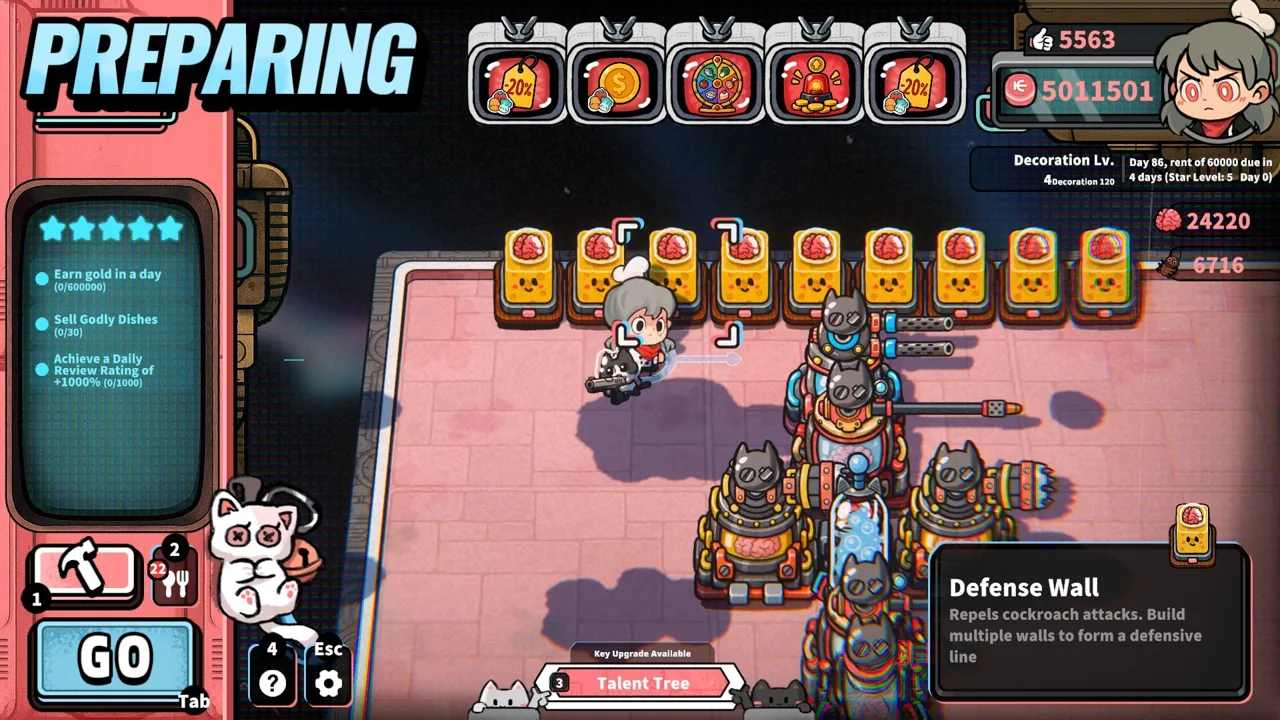 Image: Steam / GARRY
Increasing your Star Rating opens access to more recipes, structures, robots, advertisements, talents, and management systems. Expansion therefore brings new decisions alongside more space: you need to consider what the restaurant can produce and how customers move through it.
The Life, the Universe, and Restaurants demo does not have a documented Star Rating limit here. Treat the full game's progression as context rather than a promise that the trial lets you reach every tier.
A useful planning habit is to connect each purchase to a specific problem. More customer tables create room for diners, while production facilities and staff support the work required to serve them. Before expanding seating, consider whether your existing preparation and delivery workflow can handle additional orders.
The game also allows you to influence demand. Posters make customers more likely to order particular dishes, while TVs steer them toward a selected menu. Advertising can increase profits from specific dishes and change your business strategy.
| Business tool or decision | Described role | Suggested planning question |
|---|---|---|
| Additional plots | Provide room for restaurant expansion | What would you place in the new space? |
| Customer tables | Expand dining capacity | Can your current kitchen support more diners? |
| Cookware and facilities | Support food production | Which preparation task needs attention? |
| Posters | Encourage orders for particular dishes | Can you reliably prepare the promoted dish? |
| TVs | Guide customers toward a selected menu | Does that menu fit your production setup? |
| Pricing strategy | Connects with factors including queues, Coins, and special events | How does the strategy fit your current business? |
Menu specialization is another described option. You can promote the same dish repeatedly, rotate the menu, or specialize in Veggie Dishes or Meat Dishes. The listing does not establish one universal winning strategy.
If these tools appear in your trial, a good approach is to change one part of your plan at a time. Promoting a dish your kitchen already handles smoothly gives you a clearer way to evaluate advertising. Changing the menu, layout, and staffing simultaneously makes it harder to understand which adjustment helped.
When playing the Life, the Universe, and Restaurants demo, look for whether business decisions feel connected. A menu choice should give you a reason to think about preparation, serving capacity, and automation—not merely another purchase to make.
Angry Customers, Brains, and Restaurant Defense
The game's strangest management system involves deliberately unhappy customers. These patrons call themselves “gods,” and their patience can be reduced through trash bins, lighting, and other methods.
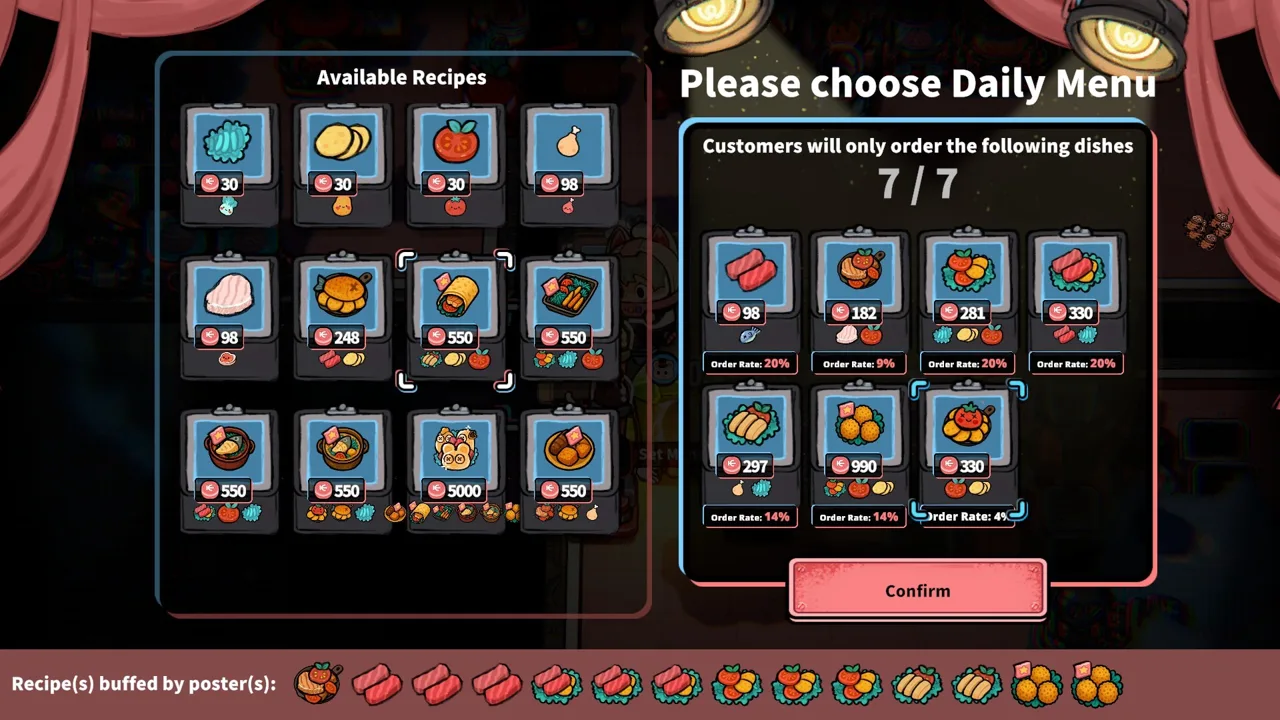 Image: Steam / GARRY
Once their patience runs out, customers become enraged. Within the game's fictional Cosmic Regulatory Bureau rules, dealing lethally with unruly customers allows you to harvest their Brains. This resource supports talent upgrades and more powerful brain-based robots.
That creates another management concern alongside cooking and profits. Customer anger can contribute to progression, but the restaurant also needs protection. The main game describes Turret Robots, Guards, and other Defense Facilities for that purpose.
If this system is accessible in the Life, the Universe, and Restaurants demo, a sensible approach is to understand the available defenses before deliberately encouraging rage. The listing describes the tools involved, but it does not specify damage values, safe layouts, combat timing, or an optimal defense arrangement.
Pay attention to how clearly the game explains patience, anger, and the use of Brains. Those relationships matter because they connect restaurant conditions with upgrades and defense.
This also establishes the game's tone. Its restaurant simulation includes fictional violence and brain harvesting as business mechanics. Players interested in the cooking premise should account for that dark humor when deciding whether the setting appeals to them.
PC Requirements and What to Evaluate in the Demo
Steam lists Windows support for the main game, with no native macOS or Linux support indicated. Its published minimum PC requirements are:
| Component | Main game's listed minimum |
|---|---|
| Operating system | Windows 10 or 11, 64-bit |
| Processor | Intel Core i5-6xxx or AMD FX-6300 |
| Memory | 8 GB RAM |
| Graphics | NVIDIA GeForce GTX 750 or AMD Radeon R7 265 |
| Storage | 1 GB available space |
These are the main game's minimum specifications. They do not establish a separate demo download size or guarantee a particular frame rate, resolution, or graphics preset.
The main listing includes full controller support, a gamepad recommendation, and a keyboard-only option. It also lists playability without timed input. Those details are useful for assessing control preferences, but any demo-specific implementation remains unspecified.
English is among the supported languages. The other listed languages are Simplified Chinese, Japanese, Korean, Traditional Chinese, French, Brazilian Portuguese, and European Portuguese. Simplified Chinese is the only language marked with full audio support.
When evaluating the Life, the Universe, and Restaurants demo, focus on the systems you can actually access. A useful trial session can help you assess whether you enjoy preparing dishes, organizing the restaurant, and improving repeated tasks.
If automation is available, consider whether recording routines gives you enough control to make meaningful changes. If expansion is available, examine whether rearranging the restaurant helps you respond to growing demand. If advertisements or defenses are absent, leave those systems out of your judgment of the demo.
Performance is another practical consideration. Observe how the available content runs on your computer, while keeping the trial's scope in mind. A small restaurant in a demo cannot establish how a much larger full-game operation will perform.
The strongest reason to check the trial is the interaction between its systems: cooking creates the workload, robots repeat the tasks, expansion changes the layout, and business decisions influence demand. Use the available demo content to decide whether solving those connected problems is something you want to keep doing.
FAQ
Is the Life, the Universe, and Restaurants demo available on Steam?
The game's Steam listing includes an associated demo with app ID 4311130. Check the main store page for the current download option; the listed app ID alone does not establish live installation availability.
When does the full game release?
Steam lists October 12, 2026 as the scheduled release date and marks the full game as coming soon. No exact launch time is specified.
How long is the demo, and does progress carry over?
Demo length, progression limits, and save transfer are unspecified. Avoid planning around a particular playtime or assuming your restaurant will carry into the full release.
Does the game support multiplayer or Mac?
The main game is listed as single-player with Windows support. Native macOS and Linux support are not listed, and no multiplayer mode is described.
Continue with
 Life, the Universe, and Restaurants developer and publisherLife, the Universe, and Restaurants developer and publisher details: meet GARRY and Gamersky Games, explore gameplay, and check the planned Steam release.
More in Release
Life, the Universe, and Restaurants FAQ: Launch Guide
Life, the Universe, and Restaurants FAQ covers the October 12 release date, PC specs, robot cooking, and restaurant upgrades. Plan your cosmic kitchen.
Life, the Universe, and Restaurants platforms and wishlist
Life, the Universe, and Restaurants platforms and wishlist guide: check Windows support, the October 12 release date, PC requirements, and Steam options.
Life, the Universe, and Restaurants release date countdown
Life, the Universe, and Restaurants release date countdown: track the October 12 Steam launch, check PC requirements, and plan your cosmic kitchen debut.
Life, the Universe, and Restaurants system requirements
Life, the Universe, and Restaurants system requirements explained: check minimum PC specs, Windows support, storage needs, and demo details before you buy.
Join the community
Official channels for news, updates and player help: