
Life, the Universe, and Restaurants Robot Action Recording
Master Life, the Universe, and Restaurants robot action recording with practical tips for cooking routines, kitchen layouts, and smoother robot teamwork.
Jump to
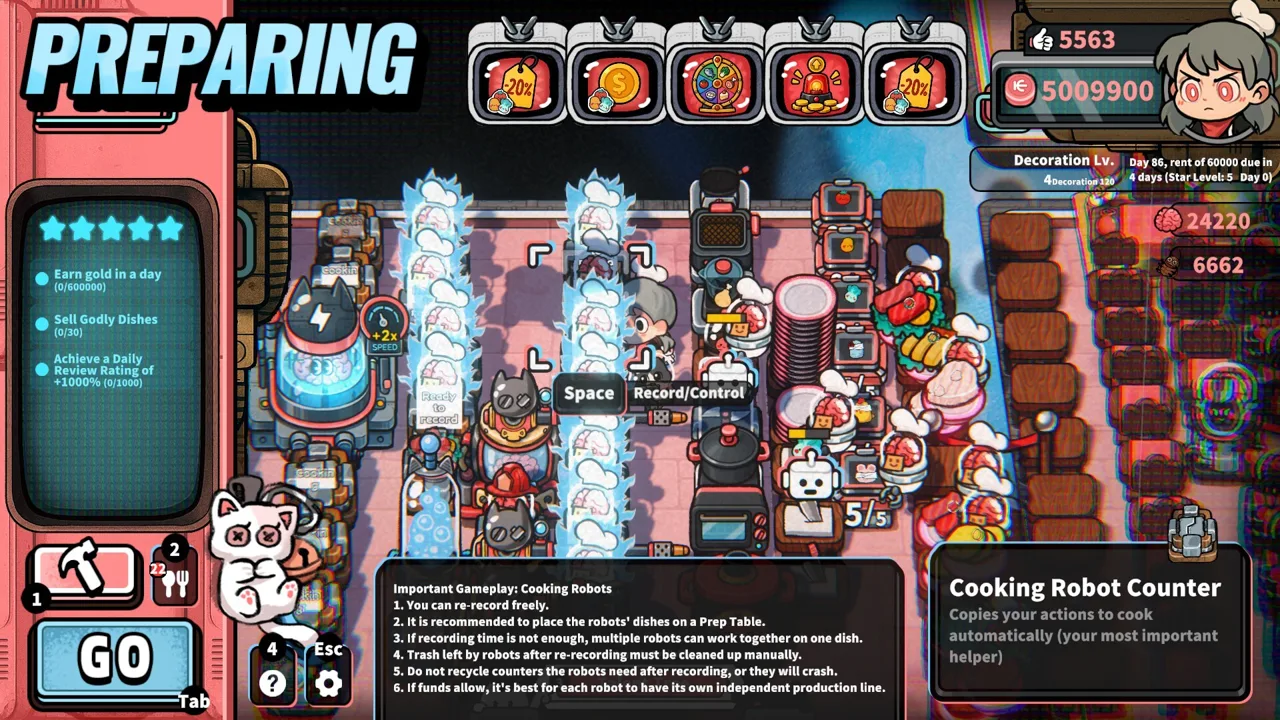
How Robot Action Recording Changes Your Kitchen
Your kitchen gets hectic fast when every order competes with cooking, serving, and collecting money. Life, the Universe, and Restaurants robot action recording lets robots repeat a routine you demonstrate, freeing you to manage the restaurant. With Life, the Universe, and Restaurants robot action recording, the challenge becomes building a workflow that keeps food moving while you handle the next problem.
The system centers on recording and replaying your actions. You perform the work, and robots repeat the routine continuously. Their responsibilities extend beyond food preparation: robots can take orders, cook, serve dishes, transport Coins, and clean up.
That gives you several ways to reduce your workload. Start by watching which responsibility repeatedly pulls you away from everything else.
| Restaurant task | Supported robot work | Planning tip |
|---|---|---|
| Taking orders | Robots can take customer orders | Delegate order collection if you keep interrupting food preparation |
| Cooking | Robots can repeat cooking routines | Practice a simple recipe before tackling complex preparation |
| Serving | Robots can deliver dishes | Keep the kitchen-to-table route compact |
| Transporting Coins | Robots can move Coins | Include money collection in your staffing plan |
| Cleaning | Robots can handle cleanup | Account for cleanup alongside production |
The restaurant still needs your decisions. You choose the layout, expand production, purchase equipment, and shape customer demand. Automation gives you room to make those decisions while repetitive work continues.
Focus on a specific problem before adding another robot. If dishes are ready but customers keep waiting, inspect serving. If you keep abandoning the cutting counter to collect money, consider Coin transport. Assign work around the interruption you want to remove.
Prepare a Routine Before Recording It
Life, the Universe, and Restaurants robot action recording begins with the routine you demonstrate. Make that routine straightforward before trying to turn it into a production line.
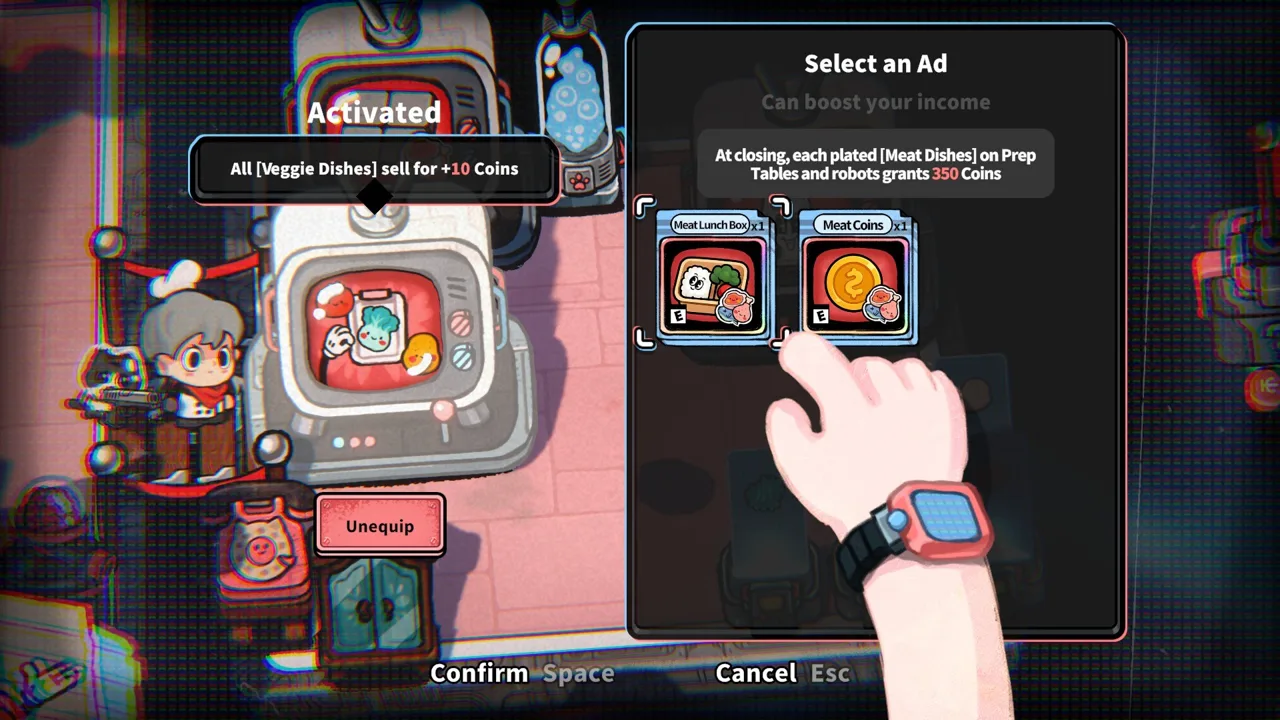 Image: Steam / GARRY
Recipes involve gathering ingredients, preparing and processing them, plating the result, and serving the finished dish. Higher-tier Recipes introduce more complicated preparation, so begin with a dish whose sequence you already understand.
Leafy salad provides a concrete example: collect a leafy folk from its container, slice it at the cutting counter, and plate the sliced ingredient. Use that simple preparation sequence to practice moving between the required stations.
Arrange Equipment Around the Recipe
Place the ingredient container, cutting counter, and plating area close enough to avoid unnecessary trips. Keep access to the workstations clear, and leave room for the restaurant’s other jobs.
Plan the arrangement around what the dish actually needs. A compact kitchen still needs usable routes between equipment and Customer Tables.
| Part of the routine | What happens | Preparation tip |
|---|---|---|
| Ingredient collection | Obtain the ingredient needed for the dish | Place its container near the relevant processing station |
| Processing | Complete the recipe’s preparation steps | Arrange equipment in the order you use it |
| Plating | Put the prepared food on a plate | Keep the plating area close to the final preparation station |
| Serving | Deliver the finished dish to a customer | Leave a clear route toward Customer Tables |
| Coin handling | Move collected Coins to the vault | Include the vault in your traffic plan |
Rehearse the sequence manually. Pay attention to every trip that takes you away from the dish, and rearrange equipment if the route feels unnecessarily long.
Use these checks before recording:
- Identify the ingredients and equipment the recipe requires.
- Practice the preparation sequence without switching to an unrelated task.
- Shorten repeated trips between stations.
- Check that the serving route remains accessible.
- Account for Coin collection and cleanup outside the cooking routine.
Keep your practice focused. Completing one familiar dish cleanly gives you a useful starting point for understanding robot replay.
Divide Complex Cooking Into Robot Sequences
Higher-tier Recipes add preparation steps, and multiple Cooking Robots can work together in sequence. That opens the door to building a production line with separate responsibilities.
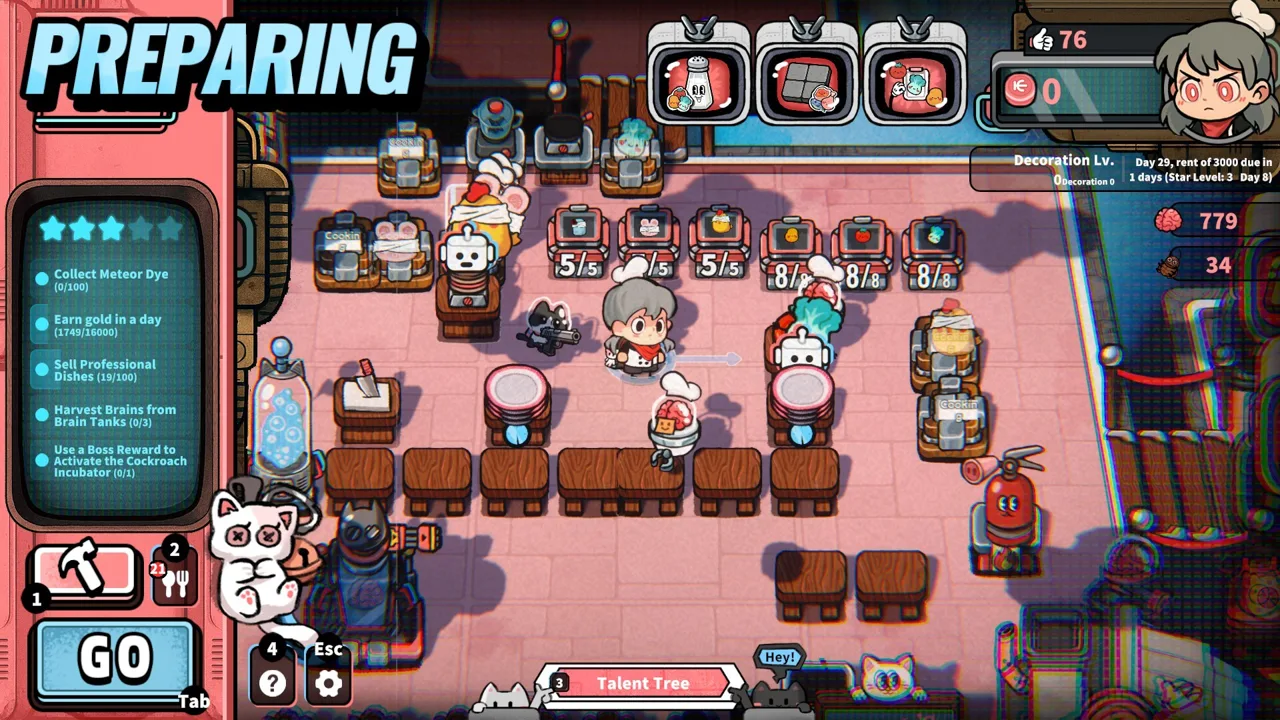 Image: Steam / GARRY
For Life, the Universe, and Restaurants robot action recording, think about where each part of a recipe begins and ends. Identify the ingredient state entering a stage and the result leaving it. Then organize the work around those transitions.
Use the following division as a planning exercise rather than a fixed staffing formula:
| Production stage | Work to organize | Layout tip |
|---|---|---|
| Ingredient preparation | Gather ingredients and complete initial preparation | Keep ingredient storage close to the relevant equipment |
| Further processing | Perform the recipe’s additional cooking steps | Place successive stations near one another |
| Plating | Assemble the prepared result on a plate | Position plating near the end of the cooking sequence |
| Delivery | Carry finished dishes to customers | Keep the route out of the kitchen clear |
Choose the divisions that match your actual recipe. A simple salad has less preparation to distribute than a higher-tier dish with several processing steps.
Watch Where Production Slows Down
When using Life, the Universe, and Restaurants robot action recording, observe the whole sequence once robots are working. Look for the point where food stops moving smoothly.
If preparation finishes while the next stage remains busy, inspect that next stage before expanding the earlier one. If finished dishes wait for delivery, focus on serving. Use the visible backlog to decide where additional equipment or staff would help.
Keep your changes targeted. Adjust one part of the workflow, watch another service period, and compare what happens. Changing the menu, kitchen layout, and staffing together makes it harder to identify which adjustment helped.
Repeat this review as you unlock new Recipes. A kitchen arranged around basic salads needs another look when more complicated dishes introduce additional work.
Balance Automation With Demand and Revenue
Cooking is only part of the restaurant’s economy. Customers leave Coins after eating, and those Coins must reach the vault to become usable funds. A busy dining room therefore creates work beyond preparing meals.
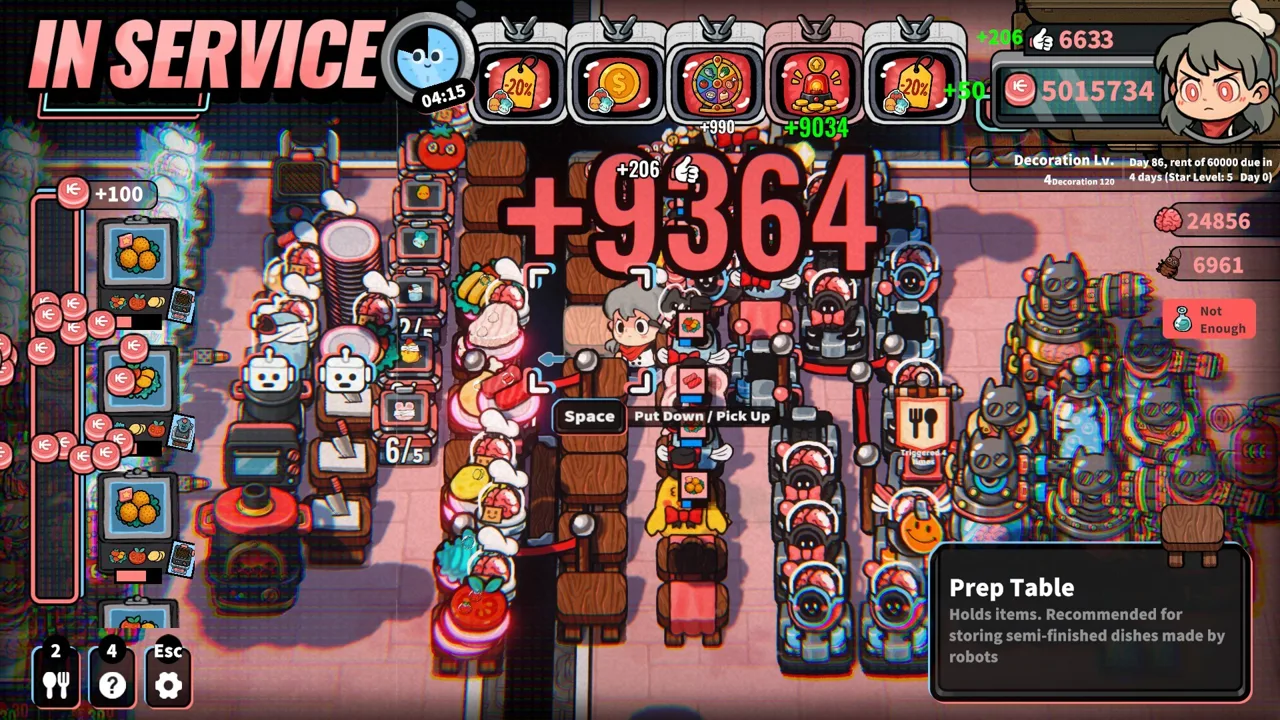 Image: Steam / GARRY
Life, the Universe, and Restaurants robot action recording can cover Coin transport as well as kitchen duties. Include that job when planning your staff, especially if money collection repeatedly pulls you away from serving.
Check the full path from order to payment:
- Take the customer’s order.
- Prepare and plate the requested dish.
- Deliver the meal.
- Collect and transport the resulting Coins.
- Handle the cleanup needed to keep service moving.
Inspect whichever part keeps demanding your attention. Improving cooking speed has limited value if you still spend service rushing between tables and the vault.
Match Advertising to Production Capacity
Posters make customers more likely to choose particular dishes. TVs can steer orders toward a selected menu, while different ads can increase profits from specific dishes.
Use those tools alongside your production plan. Promote a dish after organizing the work needed to prepare and serve it. Watch whether the extra demand creates a queue at a particular workstation or leaves completed meals waiting for delivery.
Avoid pushing a complicated recipe before its preparation sequence is manageable. Strengthen the relevant production stages, then review the advertising around that dish.
Your business strategy can combine dish prices, order rates, serving speed, and automation efficiency. Choose a menu you can support, and adjust it as your kitchen expands.
Revisit the Layout as You Gain Stars
The full version released on October 12, 2026, includes the complete progression to a 5-Star Restaurant. Increasing the Star Rating unlocks more plots, Recipes, structures, robots, ads, talents, and management systems.
Review your kitchen when those additions change the workload. Use new space to improve routes and production capacity, rather than filling every opening with another Customer Table.
Brains also contribute to progression: they support talent upgrades and unlock more powerful brain-based robots. Keep those upgrades in mind while planning the restaurant’s longer-term development.
Troubleshoot the Workflow Before Expanding
When automation feels awkward, break the problem into something you can watch: the preparation sequence, equipment access, serving, or support work.
Life, the Universe, and Restaurants robot action recording benefits from a clear demonstration and a kitchen arranged around the recorded task. Practice the troublesome part manually, then inspect how it fits into the larger restaurant.
| What you notice | What to inspect | Adjustment to try |
|---|---|---|
| Recording a complicated dish feels rushed | Length of the preparation sequence and travel between stations | Practice the sequence and shorten unnecessary trips |
| One stage has work piling up | Capacity at that point in production | Add relevant equipment or robot support as resources allow |
| Prepared dishes wait for delivery | Serving workload and the route to Customer Tables | Focus on delivery before increasing cooking output |
| Coin collection keeps interrupting you | Money transport and vault access | Allocate robot support to Coin handling |
| A promoted dish overwhelms the kitchen | Demand relative to its preparation workload | Reconsider promotion while improving that dish’s production |
For a long cooking sequence, use the game’s support for multiple Cooking Robots working in sequence. Organize the stages around the actual preparation steps instead of attempting to handle every restaurant responsibility within one routine.
Separate Production Problems From Customer Trouble
Customer patience adds another pressure. Trash Bins, lighting, and other methods can drain patience; customers who lose it completely become enraged. Impatient guests can also attack restaurant facilities.
Place those elements deliberately. If your immediate goal is smoother food service, inspect patience-draining structures around the tables as part of the layout review.
The game also lets you build around confrontation: enraged customers provide valuable Brains, and Turret Robots, Guards, and Defense Facilities support restaurant protection. Account for that strategy separately from the cooking sequence.
Finish each round of adjustments by watching the complete operation. Check whether orders become meals, meals reach customers, and Coins reach the vault. Expand after the existing workflow is manageable, then review it again when the next recipe or room changes the workload.
FAQ
How does Life, the Universe, and Restaurants robot action recording work?
You record your actions, and robots repeatedly replay the demonstrated routine. Robot duties include taking orders, cooking, serving dishes, transporting Coins, and cleaning up. Use familiar tasks to practice recording before organizing more complicated production.
Can multiple robots work together on one recipe?
Yes. Multiple Cooking Robots can work in sequence to handle the increasingly complex preparation required by higher-tier Recipes. Divide the work around the recipe’s stages, and arrange the relevant equipment to keep the sequence compact.
What should I practice before automating cooking?
Practice a recipe you understand from ingredient collection through plating. Leafy salad offers a simple sequence: collect a leafy folk, slice it at the cutting counter, and plate it. Rehearse the route and remove unnecessary travel before recording.
Can robots help with money collection?
Yes. Robots can transport Coins. Customers leave Coins after dining, and collected Coins must be moved to the vault to become usable funds. Include Coin transport in your staffing plan when collection keeps interrupting cooking or serving.
Continue with
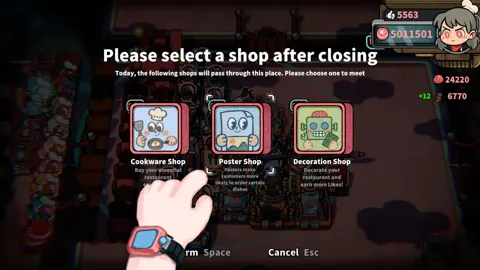 Life, the Universe, and Restaurants Robot Brains GuideLife, the Universe, and Restaurants robot brains power talents and stronger robots. Learn how to harvest Brains and build a smoother automated kitchen.
More in Automation
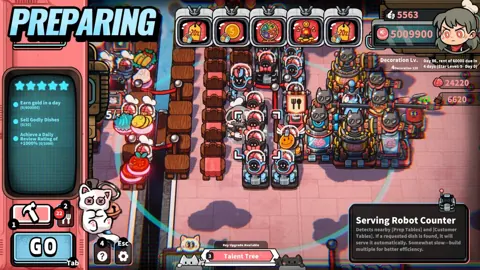
Life, the Universe, and Restaurants Automation Guide
Master Life, the Universe, and Restaurants automation with robot routines, smarter kitchen layouts, coin collection, and menu strategies. Build your crew.
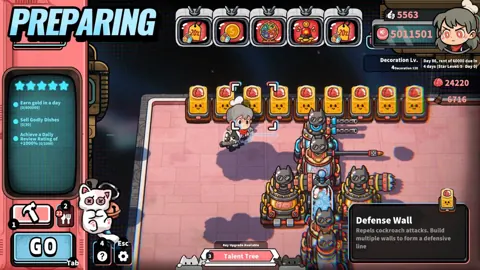
Life, the Universe, and Restaurants Transport Robot Stations
Life, the Universe, and Restaurants transport robot stations automate coin collection. Learn station placement, cover dining tables, and keep cash moving.
Join the community
Official channels for news, updates and player help: