Coming soon · Release date: October 12, 2026
UpdatedLife, the Universe, and Restaurants Beginner Cooking Guide
Use this Life, the Universe, and Restaurants beginner cooking guide to prepare salads, bank Coins, train robots, and keep your kitchen running smoothly.
Jump to
Learn the Cooking Loop Before Orders Pile Up
Your customers call themselves gods, but somebody still has to chop their salad. This Life, the Universe, and Restaurants beginner cooking guide helps you connect cooking, serving, and collecting payment before a busy restaurant pulls you in every direction. Follow the Life, the Universe, and Restaurants beginner cooking guide to practice a repeatable kitchen routine, then put robots to work on the jobs that keep interrupting it.
The Windows release is scheduled for October 12, 2026. The starter salad walkthrough below follows the early-development tutorial, while the broader restaurant systems include recipe progression, recorded robot routines, advertising, and advancement from 1 Star to 5 Stars.
Your basic job connects several tasks: take an order, gather ingredients, prepare them, plate the dish, and bring it to the customer. Learn that whole sequence before trying to juggle increasingly complicated recipes.
Practice With Leafy Salad
In the early-development tutorial, a seated customer orders Leafy Salad. That gives you a short preparation sequence to rehearse.
| Step | Action | What to watch |
|---|---|---|
| Take the order | Approach the seated customer and take their order | Identify the requested dish before fetching ingredients |
| Gather the ingredient | Pick up a Leafy Folk from its container | Head to the cutting station next |
| Prepare it | Place the ingredient on the cutting counter and slice it | Finish preparation before moving to plating |
| Plate it | Pick up the sliced leaf and plate it | Carry the prepared dish to the customer |
| Serve it | Deliver the plate to the customer who ordered it | Check the next order before starting another dish |
The early-development opening also introduces Potato Salad through a similar cutting-and-plating routine. Follow the requested recipe rather than assuming every dish shares those steps: higher-tier Recipes introduce more complex preparation.
Practice completing an order without wandering between unrelated stations. Check which customer requested the dish before delivering it, especially when several tables need attention.
The foundation of this Life, the Universe, and Restaurants beginner cooking guide is a routine you can repeat deliberately. Speed comes from removing unnecessary movement and remembering the next task.
Arrange Your Kitchen Around Cooking and Payment
Every trip across your restaurant competes with another job. Fetching an ingredient, carrying a plate, taking an order, and transporting Coins all demand attention, so arrange your kitchen around those movements.
Place ingredient containers near the stations that process their contents. Keep the route from preparation to plating easy to follow, and leave yourself a practical path back to Customer Tables.
Think through the journey of a single salad. Walk from the table to the ingredient container, then to the cutting counter, then through plating and delivery. Rearrange the layout if that route repeatedly sends you across the room.
Finish the Payment Loop
In the early-development tutorial, customers drop Coins after receiving food. Approaching those Coins collects them onto your back, but you must carry them to the vault to obtain them.
That makes payment another part of service. Serving several dishes while leaving their proceeds scattered around the restaurant creates an additional task you still need to finish.
| Task | Mechanic | Practical tip |
|---|---|---|
| Ingredient collection | Dishes begin with ingredients you gather | Put containers near their preparation stations |
| Food preparation | Recipes require preparation and processing | Group stations around the recipe sequence |
| Serving | Prepared dishes go to Customer Tables | Keep delivery routes easy to navigate |
| Coin collection | The early-development tutorial collects nearby Coins onto your back | Pick them up while moving between nearby tasks |
| Banking | Tutorial Coins must be transported to the vault | Include a vault trip in your service routine |
Make banking trips purposeful. Collect nearby Coins as you move, then deposit them without turning every payment into a separate trip across the restaurant.
Avoid expanding seating simply because you have room. Check whether you can handle the cooking, delivery, and payment work already in front of you before adding more Customer Tables.
Use this Life, the Universe, and Restaurants beginner cooking guide to evaluate the whole service cycle. If meals leave the kitchen quickly but serving or Coin transport consumes your attention, focus your next improvement there.
Teach Robots a Routine You Understand
Robots can take orders, cook, serve dishes, transport Coins, and clean up. Cooking automation works by recording a routine that robots then repeat.
That makes your manual practice useful long after you stop preparing every plate yourself. A route with unnecessary travel gives the robot unnecessary travel to repeat.
Rehearse the cooking sequence before recording it. Know where each ingredient comes from, which preparation steps it needs, and where the dish goes afterward. Remove avoidable detours from your demonstration.
Start with a manageable task. Keep complicated recipes under your direct attention until you understand their preparation sequence well enough to organize robot work around it.
| Robot job | Work it handles | What to examine afterward |
|---|---|---|
| Taking orders | Obtaining customer orders | Whether cooking and serving can keep up |
| Cooking | Repeating recorded preparation routines | Whether the routine reaches a useful finished output |
| Serving | Delivering dishes | Whether prepared food is reaching customers |
| Coin transport | Moving Coins | Whether payment collection still needs your attention |
| Cleaning | Cleanup work | Whether cleanup continues to interrupt other tasks |
Watch the entire process after introducing automation. A Cooking Robot can relieve preparation work while leaving you responsible for an increasing number of deliveries. Assign robots according to the task holding up service.
Divide Complex Recipes Into Connected Jobs
Higher-tier Recipes involve more preparation steps, and multiple Cooking Robots can work together in sequence.
Map those steps before building a larger production line. Decide what each robot should accomplish and how its output connects to the next part of the recipe. Place the relevant stations so the sequence follows a clear route.
Keep the system understandable. If dishes stop moving through preparation, inspect each stage in order rather than changing several robot assignments at once.
The automation lesson in this Life, the Universe, and Restaurants beginner cooking guide is to record useful work, observe the result, and expand from there. Build around a routine you can explain step by step.
Spend Coins to Support Recipes and Star Objectives
Your restaurant advances by completing business objectives and moving from 1 Star toward 5 Stars. As the Star Rating increases, more plots, Recipes, structures, robots, ads, talents, and management systems become available.
Check your current objectives before shopping. Choose purchases that either support the next objective or address a problem you can already see during service.
New cookware supports your developing kitchen, while additional plots provide expansion space. More Customer Tables create room to serve customers, and production facilities and robot staff support the work behind those meals.
Keep those investments connected. When a new recipe adds preparation steps, review its cookware and staffing needs alongside its potential value.
| Development choice | What it changes | Planning question |
|---|---|---|
| New Recipes | Adds dishes with increasingly complex preparation | Can your kitchen handle the added steps? |
| Cookware and production facilities | Expands your preparation setup | Which part of cooking needs more capacity? |
| Additional plots | Creates room to expand the restaurant | How will the space improve movement or production? |
| Robot staff | Automates restaurant jobs | Which repeated task needs attention? |
| Ads | Influences dish demand and business strategy | Can you handle more orders for the promoted dishes? |
Match Advertising to Your Kitchen
Posters make customers more likely to order particular dishes. TVs can guide orders toward a selected menu, and advertising can increase profits from specific dishes.
Promote meals your kitchen can prepare and deliver reliably. If a recipe already requires constant intervention, improve its workflow before encouraging more customers to order it.
Dish prices, order rates, serving speed, and automation efficiency all contribute to your business strategy. Compare those factors together when choosing what to feature.
You can specialize in Veggie Dishes or Meat Dishes, promote the same dish repeatedly, or rotate your menu. Choose a direction that fits your current preparation setup and available upgrades.
Apply this Life, the Universe, and Restaurants beginner cooking guide whenever you expand: review the objective, identify the work required, and purchase the facilities or staff that support it. Let your next investment solve a concrete problem.
Keep Customer Rage From Disrupting Your Kitchen
Cooking shares the restaurant with a stranger progression system: angry customers can become a resource.
Trash Bins, lighting, and other methods can reduce customer patience. Customers who lose patience become enraged, and unruly guests can attack restaurant facilities.
The game allows you to defend the restaurant against these customers and harvest their Brains. Brains support talent upgrades and more powerful brain-based robots. Turret Robots, Guards, and other Defense Facilities help protect your restaurant.
Keep patience manipulation deliberate. Placing Trash Bins near Customer Tables affects the guests sitting there, so consider that effect when arranging your dining area.
While learning cooking, focus on recognizing the difference between a service problem and a planned rage strategy. A crowded kitchen, unfinished dishes, and neglected deliveries all deserve your attention before you add another system to manage.
Prepare your defenses before intentionally building around enraged customers. Keep your cooking layout understandable so you can return to service after dealing with trouble.
Review Your Restaurant Before Expanding
Run through these questions when deciding what to change next:
- Can you follow each active recipe’s preparation sequence?
- Are ingredient containers close to the stations that use them?
- Can you identify which table needs each finished dish?
- Are Coin collection and transport receiving enough attention?
- Does each Cooking Robot perform the routine you intended?
- Can serving keep pace with food preparation?
- Does your planned purchase support a Star Upgrade objective?
- Are promoted dishes manageable with your current kitchen?
Change one problem at a time, then watch how the restaurant operates. If you shorten a cooking route, check the full journey through plating and delivery. If you add automation, inspect the jobs still requiring your attention.
Return to this Life, the Universe, and Restaurants beginner cooking guide as recipes become more demanding. Keep the sequence clear, connect robot jobs carefully, and expand production alongside the customers you intend to serve.
FAQ
How do you make Leafy Salad?
In the early-development tutorial, take the customer’s order, collect a Leafy Folk, place it on the cutting counter, and slice it. Pick up the sliced leaf, plate it, and deliver the dish to the customer who ordered it.
Why do I need to carry Coins to the vault?
In the early-development tutorial, nearby dropped Coins collect onto your back. Carry them to the vault to obtain them. Include collection and banking in your service routine so payment receives attention alongside cooking.
How do Cooking Robots learn recipes?
You record a cooking routine, and robots repeat it. Rehearse the preparation route before recording. As higher-tier Recipes add complexity, arrange multiple Cooking Robots to work together in sequence.
What should I focus on after this Life, the Universe, and Restaurants beginner cooking guide?
Review your current Star Upgrade objectives and the task interrupting service most often. Improve that part of the restaurant, observe your robot routines, and match advertising to dishes you can handle. You can find the game on the Life, the Universe, and Restaurants Steam page.
Popular pages
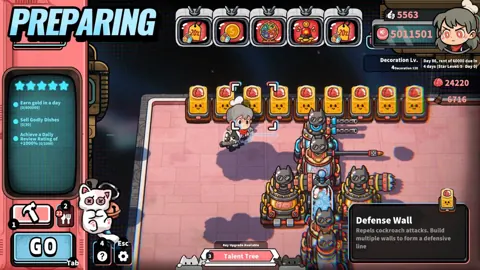
Life, the Universe, and Restaurants Platforms and Wishlist
Life, the Universe, and Restaurants platforms and wishlist guide: check Windows support, the October 12 release date, PC requirements, and Steam options.
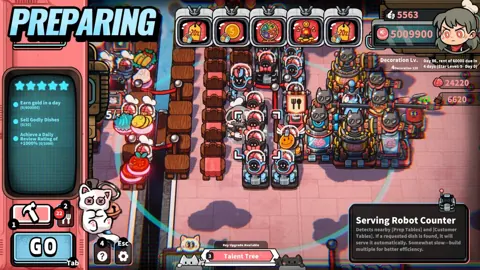
Life, the Universe, and Restaurants System Requirements
Life, the Universe, and Restaurants system requirements explained: check minimum PC specs, Windows support, storage needs, and demo details before you buy.
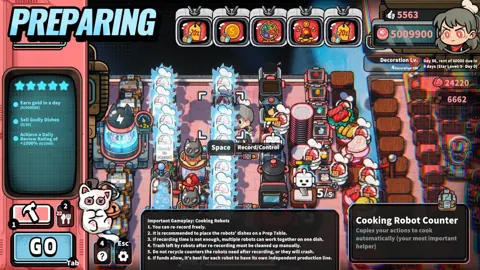
Life, the Universe, and Restaurants Trailer and Screenshots
Explore Life, the Universe, and Restaurants trailer and screenshots, with Steam videos, robot cooking, restaurant upgrades, and an October 12 release date.
Life, the Universe, and Restaurants Developer and Publisher
Life, the Universe, and Restaurants developer and publisher details: meet GARRY and Gamersky Games, explore gameplay, and check the planned Steam release.
Join the community
Official channels for news, updates and player help: